

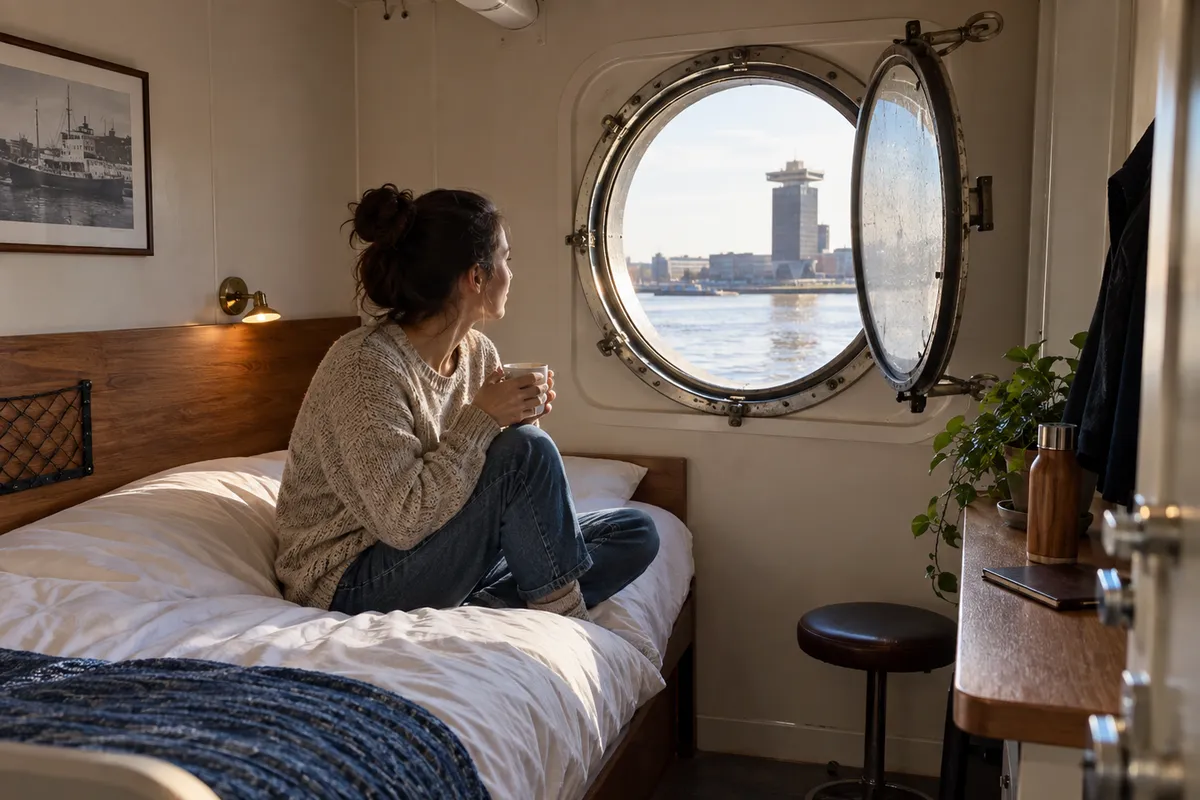
A single berth on the water reveals quirks that traditional brick-and-mortar hotel listings never show. Over twelve years and more than seventy stays aboard moored vessels across Europe and beyond, I have learned that booking solo floating hotel stays requires looking past romantic harbor snapshots to inspect steel bulkheads, gangway physics, and nocturnal mechanical noise.
When traveling alone, you cannot split the bill on a double cabin, and you carry every piece of luggage up the boarding ramp without assistance. Understanding how botels handle single occupancy, nighttime security, and acoustic isolation is the difference between a restful night over the river and an exhausting vigil next to a humming bilge pump.
Evaluating Solo Floating Hotel Stays: Core Criteria and Technical Realities
Evaluating waterborne accommodation demands a different technical framework than rating a landside hotel room. On solid ground, exterior sounds bleed primarily through double glazing, and floors remain level regardless of weather. On a river or harbor mooring, the vessel interacts continuously with tidal variation, passing hull displacement, and internal ballast systems.
For independent travelers, these physical characteristics directly impact sleep quality, personal autonomy, and the final checkout invoice. I measure every property against three non-negotiable baselines: hull acoustics under harbor traffic, boarding ramp incline under variable water levels, and the presence of arbitrary single-occupancy price markups.
Hull Mechanics, Acoustic Profiles, and Nighttime Motion
Sound travels through floating vessels through both airborne and structure-borne pathways. Watertight transverse bulkheads made from structural marine steel significantly blunt airborne noise, yet they act as acoustic conduits for physical machinery. According to a marine RF propagation study in MDPI Journal of Marine Science and Engineering, dense steel bulkheads attenuate high-frequency radio waves by roughly 20 dB per barrier, and they reflect higher-frequency airborne sounds similarly while vibrating in resonance with mechanical equipment.
In lower-deck single berths near the waterline, this structural reality means you will hear the low-frequency drone (50 to 60 Hz) of auxiliary diesel generators or automatically cycling bilge pumps. In my own stay along a busy shipping lane, I logged how external water-level wake motion from commercial river pushers creates sharp hull slaps against the waterline plates, which echo through uninsulated steel hull cabins far more acutely than street noise in an urban lodge.
Night Noise Audit: Hull Resonance vs. External River Traffic
- Bilge pump acoustic profile: Lower-deck cabins near machinery spaces pick up intermittent 50–60 Hz hums whenever automatic float switches activate.
- Water-level wake motion: Commercial barges and harbor ferries generate low swells that slap directly against waterline hull plating, waking light sleepers.
- Steel hull soundproofing: While steel walls block 20 dB of airborne chatter between cabins, structure-borne impact sounds (dropped items, heavy boots on iron stairs) transmit throughout the hull.
Gangways, Mooring Infrastructure, and Tidal Incline Challenges
Boarding a moored vessel while managing your own luggage requires stable shore-to-ship connections. Under international maritime safety regulations outlined in IMO MSC.1/Circ.1331 standards, shore-to-vessel gangways must operate safely at an angle of inclination not exceeding 30°, with angles under 25° recommended for standard passenger transit. When tides drop or river levels fall, gangway ramps steepen considerably.
During extreme low tides on tidal rivers or coastal docks, an aluminum or steel gangway ramp incline can reach that 30° threshold. Dragging a 20-kilogram roller bag up a ribbed, wet diamond-plate gangway unassisted requires considerable physical effort and non-slip footwear. When assessing botels for solo travelers, I check whether the boarding apparatus features continuous dual handrails and self-leveling treads, especially for late-night returns in rainy weather.
Gangway Safety Thresholds for Solo Baggage
Never attempt to roll multi-wheel spinner cases down an incline exceeding 25° in wet weather. If river levels drop and the ramp angles sharply, carry luggage using shoulder straps to keep both hands free for the safety stanchions.
Single Berth Economics: Navigating Supplements, Local Taxes, and Fees
Independent travelers frequently absorb disproportionate costs when booking cabins designed for couples. Traditional land hotels occasionally discount empty bed space, but high-end superyachts and design barges routinely apply a 100% single supplement penalty, billing solitary guests the entire double-occupancy room rate. True single berth floating hotels, by contrast, offer scaled single-occupancy tariffs or dedicated single berths that protect solo travel budgets.
Local municipal taxation also creates significant discrepancies in checkout totals. In Sweden, the national tax authority (Skatteverket) levies zero municipal tourist tax on overnight lodging, keeping Stockholm botel rates predictable. By comparison, Amsterdam enforces a 12.5% municipal tourist tax alongside the standard Dutch lodging VAT of 21% outlined in the Government of the Netherlands VAT guidelines, which adds substantial overhead to every night booked on the water.
| Destination & Property | Quoted Nightly Base | 3-Night Base Cost | Local Tax & Mandatory Surcharges | Total Card Checkout |
|---|---|---|---|---|
| Stockholm (The Red Boat) | 590 SEK | 1,770 SEK | 0 SEK (0% municipal tourist tax) | 1,770 SEK (~€155) |
| Stockholm (Rygerfjord Hotel & Hostel) | 650 SEK | 1,950 SEK | 0 SEK (0% municipal tourist tax) | 1,950 SEK (~€170) |
| Amsterdam (Botel Amsterdam) | €95 | €285 | 12.5% tourist tax (€35.63) + 21% VAT included in base | €320.63 |
| Copenhagen (Hotel CPH Living) | 1,400 DKK | 4,200 DKK | 500 DKK refundable deposit + foreign card surcharge | 4,700 DKK (~€630) upfront |
Interactive Filter Specification for Water Accommodations
To evaluate these options quickly, independent travelers can prioritize listings using the following functional attributes:
- Berth Configuration: Dedicated Single Berth (no single supplement penalty) vs. Standard Double Sole Occupancy.
- Sanitary Layout: Private en-suite wet room vs. shared vs private heads in the central companionway.
- Transit Independence: Direct rail/walk access vs. municipal ferry vs. remote timed water taxi.
- Acoustic Profile: Active commercial shipping channel vs. quiet, non-tidal sheltered basin.
| Property Name | City & Country | Vessel Type | Nightly From | Primary Solo Advantage | Major Solo Trade-off |
|---|---|---|---|---|---|
| Botel Albatros | Prague, Czech Republic | Botel (Refitted Ship) | €56 | Lowest entry rate; 2026 Art Deco refit across 90 cabins | Basic 14 m² layout; river traffic vibration |
| The Red Boat (Den Röda Båten) | Stockholm, Sweden | Botel & Co-living Boats | 590 SEK | Dedicated 7 m² economy single cabin; 0% tourist tax | 80 cm narrow berth; strict 23:00 desk closure |
| Rygerfjord Hotel & Hostel | Stockholm, Sweden | Botel & Hostel Ship | 650 SEK | Communal guest galley; zero tourist tax in Sweden | 70 cm compact berth; multi-ship gangway steps |
| Botel Matylda | Prague, Czech Republic | Botel & Ristorante | €85 | Historic cargo barge setting near Old Town | Town-facing cabins hear street and tram noise |
| Botel Amsterdam | Amsterdam, Netherlands | Botel & Rooftop Suites | €95 | Free 14-minute GVB ferry F4 to Central Station | 12.5% tourist tax; ferry cuts off around midnight |
| Hotel CPH Living | Copenhagen, Denmark | Floating Hotel Ship | 1,400 DKK | Floor-to-ceiling glass; marine geothermal heating | 500 DKK deposit; steep gangway; no elevator/AC |
| OFF Paris Seine | Paris, France | Floating Catamaran Hotel | €150 | Secure keycard pontoons; social plunge pool lounge | Bar noise bleeds into lower cabins; €8.45 tax |
| Sunborn London Yacht Hotel | London, United Kingdom | Superyacht Hotel | £180 | 24-hour reception; 350 m to Custom House Elizabeth Line | 100% single supplement; isolated evening docklands |
| Fingal | Edinburgh, United Kingdom | Luxury Floating Hotel Ship | £264 | Exceptional safety; full Scottish breakfast included | 100% single supplement; Leith location requires bus/tram |
| River Kwai Jungle Rafts | Sai Yok, Thailand | Eco Bamboo Rafts | 3,200 THB | Off-grid digital detox; complete river immersion | No electrical outlets; unheated river cold shower |
| The FloatHouse River Kwai Resort | Sai Yok, Thailand | Floating Boutique Villas | 4,800 THB | Spacious private balcony over running water | Sole reliance on scheduled pier boat transfers |
| 500 Rai Floating Resort | Ban Ta Khun, Thailand | Floating Lake Resort | 14,000 THB | Wilderness lake setting; solitary guided excursions | Boat transfers strictly twice daily (11:30 & 15:00) |
| Arctic Bath | Harads, Sweden | Floating Spa Hotel | 5,995 SEK | Free-floating cabin in summer; winter ice immersion | High solo cost; cabins freeze solid mid-Nov to mid-Apr |
Budget-Friendly Botels for Solo Travelers: Tested European Berth Stays
Budget botels represent some of the most cost-effective central beds across European capitals. While standard downtown hotels push solo room rates upward, retrofitted passenger ships and cargo barges offer compact single berths tailored specifically for unaccompanied travelers who value central water frontage over oversized square footage.
However, running budget operations on water comes with tangible trade-offs in companionway noise, berth width, and reception hours. If you plan to spend days exploring and only require a secure, dry place to sleep, these vessels provide genuine utility when approached with realistic expectations. For a broader look at how these conversions operate across the continent, read my guide to European urban botels.
Stockholm Waterfront Berths: Den Röda Båten and Rygerfjord on Söder Mälarstrand
Stockholm’s Söder Mälarstrand mooring offers prime access to Södermalm and views across Lake Mälaren toward City Hall. Here, two historic vessels provide dedicated single-berth pricing without penalizing solo guests. The Red Boat (Den Röda Båten) operates two permanently moored vessels: a 1914 steamer hull and a 1946 survey ship. Its Economy Single Cabin measures roughly 7 m² with an 80 cm wide bed and shared hallway facilities, with entry rates starting from 590 SEK per night.
A short walk down the quay, Rygerfjord Hotel & Hostel spans three interconnected vessels. Its single cabins feature narrower 70 cm berths from 650 SEK per night, but Rygerfjord incorporates a communal guest galley where solo travelers can prepare simple meals. Boarding Rygerfjord with heavy bags requires traversing multiple ship-to-ship gangway steps, whereas Den Röda Båten has a simpler gangway setup.
Operational timing is critical at Den Röda Båten: front desk check-in closes strictly at 23:00, with property-wide quiet hours enforced between 23:00 and 06:00. Arriving past 23:00 means you risk lock-out if you miss pre-arranging access codes. For independent travelers keeping early hours, both ships provide an affordable harbor stay with zero Swedish municipal tourist tax added at checkout.
Prague River Barges: Botel Albatros and Botel Matylda on the Vltava
Prague’s Vltava river botels sit within easy walking distance of the historic core, but their acoustic environments differ dramatically based on hull positioning and street traffic. Botel Albatros reopened in 2026 after an extensive capital refit that introduced 1930s Art Deco interiors across 90 cabins, including 84 standard 14 m² rooms starting from €56 per night. Its berths are straightforward, clean, and provide private heads, making it an exceptional budget value for a solo base in central Prague.
Upstream along Masarykovo nábřeží, Botel Matylda offers a boutique setting split across the historic cargo barge Matylda (6 rooms) and the newer Klotylda (18 rooms), starting from €85 per night. While Matylda delivers rich wood finishes and genuine character, solo travelers must pay close attention to room selection. Quayside "Town View" cabins sit meters from the busy Masarykovo roadway and tram tracks (lines 14 and 17 stop at Jiráskovo náměstí), where steel tram wheels screech along the cobbles from early morning.
Booking a "River View" cabin on either vessel directs your portholes outward toward the river, using the water's open surface to dampen urban traffic. For independent travelers who require quiet sleep after walking Prague’s cobblestones, paying the slight premium for a river-facing cabin on Matylda or choosing an outward-facing berth on Albatros is essential.
Amsterdam NDSM Waterfront: Industrial Solo Living at Botel Amsterdam
Moored at the northern NDSM Wharf, Botel Amsterdam offers a functional base in the city’s post-industrial creative sector. Standard solo-friendly cabins start from €95 per night. The primary advantage of this location is transit connectivity: the free municipal GVB ferry F4 shuttles passengers between NDSM Wharf and Amsterdam Centraal in 14 minutes, offering frequent water-level commutes across the IJ.
The logistical catch for independent travelers lies in the ferry schedule. According to the official GVB ferry line F4 schedule, direct F4 service cuts off around 23:45 on weeknights, extending to roughly 02:00–03:00 on weekends. If you stay out late in the city center during the week, you must catch the 24-hour F3 ferry to Buiksloterweg and navigate several kilometers across Amsterdam-Noord, or take the GVB Night Bus N93, which costs €5.70 per ride via OVpay contactless ticketing.
Budget planning must also account for Amsterdam's strict lodging charges. In 2026, the 12.5% municipal tourist tax and Dutch lodging VAT add noticeably to your final bill. Botel Amsterdam remains a convenient, secure launchpad for solo museum visits and studio tours, provided you track the ferry schedule before heading out for the evening.
Mid-Range and Boutique Floating Hotels: Urban Waterfront Solitude
Mid-tier floating hotels combine custom naval architecture with contemporary boutique interior design. These purpose-built catamarans and retrofitted barges emphasize clean aesthetic lines, generous public decks, and elevated waterfront dining. For the solo traveler, they offer a calmer alternative to crowded city-center hotels, but their open designs introduce specific privacy and environmental considerations.
When staying aboard design-forward vessels, private en-suite heads and floor-to-ceiling glass come standard, but heating, cooling, and gangway access can vary widely depending on the ship's underlying engineering.
Design and Efficiency on European Rivers: OFF Paris Seine and Hotel CPH Living
In Paris, OFF Paris Seine sits permanently moored at Quai d'Austerlitz. As a stationary 58-cabin catamaran hull, it features a central plunge pool and an active floating lounge bar, with room rates starting from €150 per night plus an €8.45 municipal tourist tax. The ship offers high-level security via keycard-gated gangways and a staffed 24-hour desk. However, solo guests should be aware that the popular deck bar generates noticeable music and cocktail crowd chatter that carries directly into lower-deck cabins until closing time.
By contrast, Hotel CPH Living in Copenhagen’s Christianshavn neighborhood offers a distinctly tranquil atmosphere. Converted from a German cargo barge, its 12 water-facing cabins start from 1,400 DKK per night. The design features floor-to-ceiling panoramic glass and an innovative seawater heat-pump underfloor heating system that keeps rooms warm during Scandinavian chills.
The trade-offs at CPH Living are practical: there is no elevator, no air conditioning for warm summer days, and low tide creates a steep gangway that demands steady footing. The property also enforces a mandatory 500 DKK refundable security deposit via credit card prior to arrival and levies a card processing surcharge on foreign non-Danish credit cards. For solo travelers seeking minimalist calm, it remains a standout choice along the canal.
Safety, Keycard Security, and Solo Navigation on Urban Quays
Navigating industrial quays, docklands, and riverbanks late at night represents a distinct safety consideration for solo travelers. Unlike city hotels with active street frontage and doormen, botels are often berthed along working quays or recreational paths that grow quiet and poorly lit after dark.
When evaluating a floating property, check whether access to the shore-side gangway is secured by a perimeter security gate requiring an active keycard. Unattended botels that rely solely on four-digit mechanical pin pads on the exterior cabin doors leave guests vulnerable to trespassers wandering off public river promenades. A staffed reception desk positioned between the gangway and the cabin companionway provides critical peace of mind for solo travelers returning late.
5 Waterfront Security Checks Before Confirming an Unattended Moored Cabin
- Gated gangway controls: Ensure the shore-side approach requires keycard validation before stepping onto the floating pontoon.
- Reception staffing: Verify whether desk personnel remain on board 24/7 or if the boat switches to remote telephone support overnight.
- Quay illumination: Check satellite views to ensure the pedestrian path connecting public transit to the mooring is properly lit.
- Door locking mechanisms: Look for commercial RFID card locks or high-grade physical deadbolts rather than standard residential door handles.
- Emergency egress routes: Locate secondary gangways or safety ladder placements on the mooring pontoon in case water levels surge.
Luxury Superyachts and Heritage Ships: Premium Solo Escapes
Stepping onto a luxury yacht hotel or a preserved heritage tender elevates service and onboard amenities, offering fine dining, dedicated concierge assistance, and spacious decks. For an independent traveler looking to celebrate a personal milestone or unwind in total comfort, these ships offer unmatched maritime atmosphere.
However, the pricing model in this category rarely accommodates single occupancy. Luxury operators price cabins by the room rather than per person, enforcing a strict 100% single supplement policy where solo guests pay the full double-occupancy rate. To understand the physical dynamics of these larger vessels before booking, you can explore my analysis of motion sickness on moored floating hotels.
London and Edinburgh Stays: Sunborn London and Fingal
Sunborn London Yacht Hotel is a permanently moored 120-meter luxury yacht berthed in the Royal Victoria Dock, just 350 meters from the Custom House Elizabeth Line and DLR station. Classic Dock View cabins start from £180 per night. Because Sunborn functions as a full-service hotel, solo travelers pay the entire double-occupancy room price, but benefit from 24-hour staffed reception, elevator access across decks, and wide, level gangways that accommodate rolling luggage easily. The immediate docklands area can feel somewhat deserted on non-event evenings, making the onboard restaurant the most convenient dinner option.
In Edinburgh’s historic port of Leith, Fingal offers an exceptional boutique conversion. Formerly a working lighthouse tender for the Northern Lighthouse Board, Fingal now houses 23 luxury cabins starting from £264 per night, which includes an exceptional full Scottish breakfast. The interior showcases polished timber, curved Art Deco corridors, and immaculate deck engineering.
While Fingal enforces the same 100% single supplement as Sunborn, its onboard security, quiet dockside setting at Alexandra Dock, and attentive staff make it one of the most welcoming luxury stays in the UK for unaccompanied guests. Getting to Edinburgh's city center requires a short tram or bus ride from Leith, keeping the ship insulated from downtown noise.
Connectivity and Remote Work from a Steel Hull Berth
Working remotely from a floating hotel can be an inspiring experience, but marine structural design presents unique obstacles for digital nomads. Heavy watertight bulkheads and reinforced steel deck plating create a natural Faraday cage effect, attenuating wireless signals by approximately 20 dB through each structural wall. If a botel relies on a single Wi-Fi router mounted in the central lounge, interior cabins below the waterline will suffer from dropped connections and weak bandwidth.
Before booking a solo work stay, verify whether the vessel has installed discrete wireless access points inside each cabin or along every accommodation corridor. Cellular tethering is often effective in top-deck suites with exterior windows, but lower berths sit below the concrete quay wall, where 4G and 5G cellular signal penetration drops substantially. If your work demands video conferencing, look for properties that explicitly cite dedicated fiber backhauls, or review my guide on floating hotels for remote work.
Workstation Audit for Cabin Productivity
- Power outlet placement: Heritage ships frequently position electrical outlets inconveniently far from cabin desks or vanity tables; carry a 2-meter braided extension cable.
- Desk dimensions: Converted cabin desk surfaces are frequently narrower than 45 cm, barely accommodating an open 14-inch laptop.
- Cellular backup: Test cell reception with cabin doors open and closed; steel bulkheads can reduce data speeds significantly once latched shut.
Off-Grid and Wilderness Rafts: Solo Immersion on Distant Waters
Venturing away from urban river moorings leads to wilderness floating lodges where daily life is governed by natural water flow, jungle sounds, and boat transfers. For independent travelers seeking solitude, these off-grid stays provide an environment where you can completely disconnect.
However, remote waters remove the safety net of nearby municipal services. Medical clinics, convenience stores, and alternative transit options are hours away, making advance logistical planning essential for solo travelers.
River Kwai and Lake Cheow Lan: Off-Grid Thailand Rafts
In Thailand's Kanchanaburi province, River Kwai Jungle Rafts provides genuine off-grid accommodation starting from 3,200 THB per night. Built from local bamboo and timber, these floating rafts feature zero in-room electrical outlets, relying exclusively on evening kerosene lanterns for light and unheated, river-fed plumbing for showers. The swift current of the River Kwai hums constantly beneath the floorboards, creating a natural white-noise environment that encourages deep rest, provided you are prepared to charge electronic gear at the central service raft.
Downriver, The FloatHouse River Kwai Resort provides a boutique contrast from 4,800 THB per night, featuring air-conditioned thatched villas with modern amenities, accessed solely by scheduled long-tail boat transfers from Phutakien Pier (Resotel Pier). For wilder isolation, 500 Rai Floating Resort on Cheow Lan Lake in Khao Sok National Park offers floating villas from 14,000 THB per night.
The logistical reality at 500 Rai is strict: scheduled long-tail boat transfers depart from Ratchaprapha Dam Pier only twice daily, at 11:30 and 15:00. Missing one of these transfer windows leaves an independent traveler stranded at the dam, requiring private long-tail charters costing thousands of baht to reach the resort. Solo travelers must build ample padding into their overland transit schedules to hit these pier departures reliably.
Wilderness Float Packing Essentials for Solo Travelers
Always carry a certified 20,000 mAh external power bank and a rugged 15-liter dry bag when boarding long-tail river transfers. Sudden river spray or monsoon showers will saturate standard backpacks during open-boat runs.
Extreme Isolation: Arctic Bath and Remote Wilderness Pontoons
For solitude in subarctic environments, Arctic Bath in Harads, Sweden, features six floating Water Cabins (24 m²) starting from 5,995 SEK per night. The engineering here adapts directly to seasonal shifts: the cabins drift freely on the open waters of the Lule River during the mild summer months, but freeze solidly into river ice from mid-November to mid-April, creating a unique winter retreat centered on cold baths and sauna rituals. For cold-weather logistics, consult my guide on winter floating hotel stays.
Even deeper isolation exists at properties like Uakari Floating Lodge in Brazil's Mamirauá Reserve, reached by an 80-minute speedboat run from Tefé with packages around $600 per night, or the solitary offshore Underwater Room at The Manta Resort off Pemba Island, Tanzania, which costs $1,700 per night for an anchored pontoon where the bedroom sits four meters beneath the ocean surface. When booking wilderness pontoons alone, confirm their satellite communication protocols, check that lifejackets are present in your cabin, and ensure staff maintain scheduled safety checks throughout your stay.
The Independent Traveler’s Final Verdict: Choosing Your Moored Cabin
Selecting the right waterborne stay requires matching your budget, physical agility, and work requirements against the realities of marine hulls. Floating accommodations provide perspective and tranquility that terrestrial hotels cannot duplicate, but they require compromise when it comes to storage space, accessibility, and noise control.
Best Floating Stays by Solo Scenario
To help you decide where to drop anchor on your next solo trip, consider these recommendations based on tested field performance:
- Strict Budget & Zero Tourist Tax: The Red Boat (Stockholm) offers dedicated 7 m² single cabins from 590 SEK without single supplements or municipal tourist taxes, provided you arrive before the 23:00 desk curfew.
- Self-Catering & Extended City Stays: Rygerfjord Hotel & Hostel (Stockholm) gives independent travelers access to an onboard guest kitchen to prepare meals while overlooking Lake Mälaren.
- Low-Cost Central European City Break: Botel Albatros (Prague) provides refitted Art Deco comfort from €56 per night, keeping you within easy walking distance of the historic Old Town.
- Design, Nightlife & Quayside Socializing: OFF Paris Seine (Paris) pairs secure keycard access with a lively pool deck and cocktail lounge for travelers who enjoy social energy right outside their door.
- Heritage Maritime Luxury & Solo Safety: Fingal (Edinburgh) delivers exceptional dining, attentive service, and tranquil docklands security, well worth the double-occupancy room investment.
- Unplugged Off-Grid Retreat: River Kwai Jungle Rafts (Kanchanaburi) strips away modern digital distractions with kerosene-lit bamboo rooms over running river currents.
Trade-Off Assessment: When to Choose Land Over Water
Moored vessels are not suitable for every trip or every traveler. Before confirming a reservation on the water, review these critical factors that indicate a traditional land-based hotel would be a safer, more comfortable choice:
- Vestibular Motion Sensitivity: If you experience persistent motion sickness or balance issues, even slight river swell from passing barges can cause sleep disruptions.
- Mobility and Luggage Limitations: If you travel with multiple heavy suitcases or have limited mobility, navigating gangways that exceed a 25° incline during low tides can pose a genuine safety risk.
- Sensitivity to Low-Frequency Mechanical Noise: If the cycling sound of bilge pumps or auxiliary generator hums disrupts your sleep, lower-deck cabins will prove frustrating.
- Critical Remote Work Schedules: If your stay depends on non-stop high-bandwidth video conferencing, historic steel hulls without in-room Wi-Fi routers introduce unnecessary connection risks.