

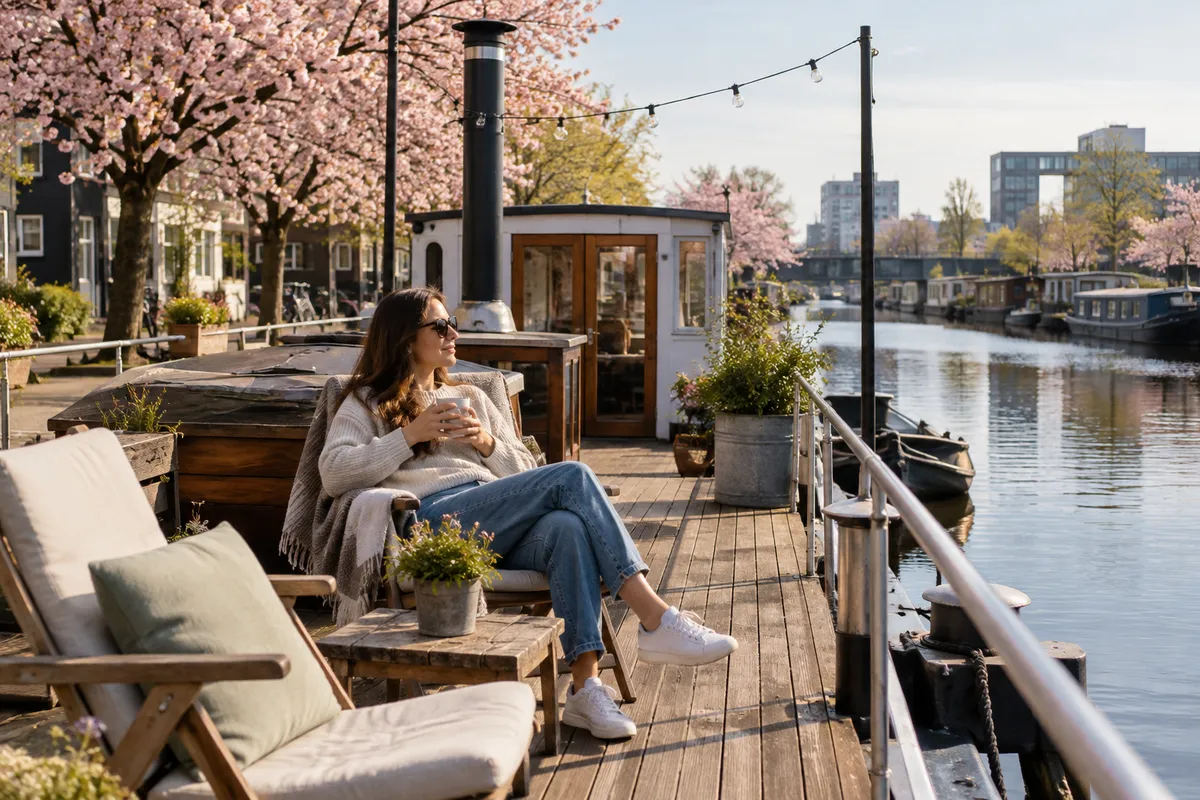
Stepping onto an open barge deck in late March brings a distinct sensory shift: the smell of damp timber drying under the first warm afternoon sun, the creak of mooring lines adjusting to spring river flow, and canal embankments turning pale green. Shoulder season boat hotels offer front-row access to urban waterways just as canal trees bud and sun decks emerge from winter tarpaulins. Yet spring floating hotel stays also bring specific technical challenges: cold harbor waters keeping lower hulls chilly, temperamental heating systems, and waking swells as seasonal boat traffic resumes.
Over twelve years living across converted barges and harbor botels, I have learned that a floating stay during the shoulder season requires very different planning than booking a standard room on solid ground. Between March and May, water temperatures lag weeks behind air temperatures, creating distinct thermal conditions inside steel hulls. In this guide, I examine field-tested data across nine European floating hotels, covering deck accessibility, hull stability, true costs after tourist taxes, and heating performance so you know exactly what happens on board before you book.
How I Evaluated Spring Floating Hotel Stays: Selection and Methodology
Core Screening Criteria for Spring Canal Boat Hotels and Botels
To identify the most dependable spring canal boat hotels, I applied strict operational baselines. A floating hotel during unpredictable spring weather cannot rely on temporary fixtures or off-grid improvisation. Each vessel had to satisfy five operational requirements:
- Permanent Shore-Side Utility Connections: The vessel must feature continuous shore power, municipal freshwater mains, and direct quayside sewage lines, completely eliminating the drone and vibration of night-time diesel generators.
- Documented Maritime Shoulder Heating: Cabins must feature active heating infrastructure capable of maintaining warmth against single-digit water temperatures, whether through radiant hydronic subfloors, individual electric convectors, or reversible heat pumps.
- Certified Public Deck Access: The ship must maintain an approved upper sun deck or open-air promenade legally accessible to resident guests during early spring.
- Rapid Transit Proximity: Berths must sit within a 500-meter walk of high-frequency public transit, such as a metro line, commuter rail link, or scheduled public transit ferry dock.
- Floral and Waterfront Corridor Access: Mooring locations had to provide immediate pedestrian or single-transit connections to spring botanical landmarks, including canal-side cherry blossom promenades and regional bulb-field transit hubs.
I deliberately excluded unregulated private houseboats rented via peer-to-peer apps. Unregulated craft often lack fixed commercial gangways with non-slip safety treads, leaving guests vulnerable to icy morning moisture, oscillating water pressure, and unmonitored bilge pump cycles.
The Shoulder Season Evaluation Matrix: Weather, Waterways, and Amenities
Evaluating floating accommodations in the shoulder season requires looking beyond decorative brass fittings and interior styling. I assessed every vessel using a four-part weighted scoring framework designed for early spring conditions:
- Thermal Stability and Insulation (30%): How effectively the hull insulation, bulkhead lining, and glazing isolate the bed from damp river air and cold steel plates.
- Basin Protection and Swell Exposure (25%): The physical geography of the mooring. Enclosed, lock-gated docks provide calm water, whereas berths on primary river channels experience lateral rocking whenever passing traffic produces wash. Navigation schedules vary by port authority rather than following an arbitrary date, so wake exposure must be evaluated against local fairway traffic.
- Deck Usability (25%): Whether upper decks are truly functional in early spring. Operators often keep exterior furniture, sun loungers, and awnings stowed in storage holds until late spring to avoid rain and frost damage, leaving open decks bare for walking.
- Spring Sightseeing Footprint (20%): Measured transit efficiency from the gangway to seasonal floral displays, such as the Keukenhof transit hub in Amsterdam or the Kungsträdgården sakura groves in Stockholm.
Master Comparison of Floating Hotels in Spring: Rates, Berths, and Trade-Offs
Spring Botel Comparison Table and Recommended Sorting Logic
To help you choose the right accommodation for your route, the table below compiles verified starting rates, waterway types, and operational trade-offs for nine reviewed vessels. When filtering, sort by Berth Waterway Type if you are prone to motion sickness: enclosed commercial docks eliminate surface roll, while river berths offer active waterfront movement.
| Name | City | Berth Waterway Type | Price From | Primary Spring Advantage | Operational Drawback & Heating Note |
|---|---|---|---|---|---|
| Botel Amsterdam | Amsterdam, NL | Industrial River Harbor (IJ) | €95 | Complimentary 24/7 GVB ferry F4 to Centraal; open roof deck | Exposed industrial harbor winds; basic compact cabins; central heating |
| Hotel Asile Flottant | Amsterdam, NL | Sheltered Side Canal (Johan van Hasseltkanaal) | €165 | Sheltered De Ceuvel canal mooring; six restored historic hulls | Self-managed heating units; self check-in without 24-hour reception |
| Botel Matylda | Prague, CZ | Active River Embankment (Vltava) | €85 | Front-row Masarykovo nábřeží location; onboard Italian terrace | Wake swell from river tour craft; cargo barge hull transfers footstep noise |
| Botel Albatros | Prague, CZ | Active River Embankment (Vltava) | €56 | Lowest entry rate; 90 cabins fully refitted in Art Deco (Sept 2026) | Compact former river-cruiser cabin dimensions; communal dining lounge |
| OFF Paris Seine | Paris, FR | Urban River Berth (Seine / Left Bank) | €150 | Heated plunge pool (07:00–16:30); active floating cocktail deck | Busy evening lounge traffic; high city tourist tax of €8.45 per night |
| Sunborn London Yacht Hotel | London, UK | Gated Enclosed Basin (Royal Victoria Dock) | £180 | 108m superyacht; zero tidal roll; 350m to Elizabeth Line | Modern docklands perimeter lacks traditional canal atmosphere |
| Hotel CPH Living | Copenhagen, DK | Open Harbor Channel (Christianshavn) | 1,400 DKK | Floor-to-ceiling glass water views; radiant floor heating | Strict 18:00 front desk closure; cool down-draft off large glass walls |
| Mälardrottningen Yacht Hotel | Stockholm, SE | Sheltered Lake Arm (Lake Mälaren / Gamla Stan) | 625 SEK | 1924 classic yacht; 300m to Gamla Stan; walkable cherry blossoms | Narrow companionways; authentic compact maritime wet rooms |
| Rygerfjord Hotel & Hostel | Stockholm, SE | Sheltered Lake Embankment (Lake Mälaren) | 650 SEK | Three-ship complex directly facing Stockholm City Hall | Transits between vessels require walking across exposed open gangways |
Berth Stability Tip: If you are sensitive to movement, choose an enclosed basin like London's Royal Victoria Dock over river berths. Locks seal the basin from tidal flows, keeping the ship as motionless as a concrete foundation while preserving water-level views.
Decoding Spring Value: City Taxes, VAT Shifts, and Hidden Mooring Surcharges
Advertised cabin rates for shoulder season boat hotels can be misleading without factoring in national sales tax shifts and municipal tourist surcharges. In 2026, the Netherlands increased its national VAT on short-stay accommodations from 9% to 21%, significantly shifting gross totals for Dutch botels. Combined with Amsterdam's flat municipal tourist tax of 12.5% applied to net room rates, staying on the water in Amsterdam incurs substantial statutory overhead.
By contrast, other European hubs structure water stays differently. In Paris, staying at a 4-star floating hotel like OFF Paris Seine incurs a flat municipal taxe de séjour of €8.45 per adult per night. In Prague, the municipal tourist fee remains modest at 50 CZK (approximately €2.00) per adult per night across both Matylda and Albatros. At Hotel CPH Living in Copenhagen, independent desk operations require paying attention to pre-authorization holds: credit card processing fees for non-EU cards and a mandatory damage deposit of 500 DKK are authorized before arrival.
Shoulder Season Out-of-Pocket Cost Calculator
Compare total accommodation costs including mandatory local taxes for a three-night stay in spring 2026:
- Amsterdam (Botel Amsterdam @ €95 base): €285 room + €59.85 VAT (21%) + €35.63 city tax (12.5%) = €380.48 total
- Paris (OFF Paris Seine @ €150 base): €450 room + €25.35 tourist tax (€8.45 × 3 nights) = €475.35 total
- Prague (Botel Albatros @ €56 base): €168 room + €6.00 city tax (50 CZK × 3 nights) = €174.00 total
Western European Canals: Tulip Runs, River Decks, and Tideless Docks
Botel Amsterdam and Hotel Asile Flottant: Keukenhof Proximity and NDSM Waters
Spring in the Amsterdam harbor revolves around the Dutch bulb bloom. The official Keukenhof tulip gardens welcome visitors from March 19 to May 10, establishing the peak travel window for canal and harbor stays. Choosing a floating base during this season depends on whether you value rapid transport logistics or quiet canal waters.
Botel Amsterdam sits moored at the industrial NDSM Wharf. The property offers 175 standard cabins starting from €95 per night, topped by five bespoke loft letter suites spelling out B-O-T-E-L. The primary advantage here is logistics: the complimentary GVB ferry service (line F4) docks right beside the vessel, running 24 hours a day and reaching Amsterdam Centraal in 14 minutes. From Centraal, travelers can transfer directly to Keukenhof express bus routes. However, the open waters of the IJ harbor expose the vessel to sharp spring winds, and standard cabins feature centralized hydronic radiators without individual digital thermostats.
Across the district along the sheltered Johan van Hasseltkanaal, Hotel Asile Flottant presents a completely different model. Comprising six lovingly restored historic freight vessels moored within the De Ceuvel clean-tech park, rates start from €165 per night. Moored inside a narrow, dead-end canal cut, Asile Flottant experiences zero commercial water traffic wake. The operational trade-off is self-reliance: entry is via digital smart-lock keycodes, there is no round-the-clock physical front desk, and cabins rely on individual pellet stoves or supplemental electric convectors that require manual temperature adjustment.
OFF Paris Seine: Seine Sun Decks and Early Shoulder Season Logistics
Moored at 86 Quai d'Austerlitz on the Left Bank, OFF Paris Seine is a custom-built 58-key catamaran botel consisting of 54 cabins and 4 suites, with spring nightly rates starting from €150. Its twin-hull aluminum construction offers stability against the continuous flow of the River Seine, though the wake from passing river cruisers occasionally creates low-frequency reverberations through the pontoons.
The ship's centerpiece is its open-air central deck and plunge pool. The pool is heated and reserved exclusively for resident hotel guests between 07:00 AM and 04:30 PM. While water temperatures are maintained for swimming, brisk spring air along the Seine corridor (often 12°C to 15°C in April) means morning dips require quick transitions to warm towels. From 16:30 onward, the poolside deck transforms into a floating cocktail bar open to outside patrons. If your cabin faces the central lounge, soundproofing shields most music, but vibration from footsteps on the wooden deck decking remains audible until closing.
Catamaran Hull Sound Transfer: Aluminum catamaran pontoons transmit mid-frequency sound efficiently. If you sleep lightly, request a water-facing cabin looking outward toward the quayside rather than an inward-facing room adjacent to the deck pool and bar.
Sunborn London Yacht Hotel: Royal Docks Stability and Elizabeth Line Access
Docked permanently in East London, the Sunborn London Yacht Hotel is a purpose-built 108-meter non-motorized superyacht berthed at Royal Victoria Dock, offering spring rates from £180. Because it rests in an enclosed deep-water dock separated from the River Thames by operational lock gates, the ship is isolated from tidal currents, commercial river traffic, and lateral swell.
For visitors traveling to central London's royal parks to view spring blossoms, the yacht's location offers exceptional transit efficiency. The gangway sits exactly 350 meters from Custom House station, where the Elizabeth Line delivers travelers directly to Bond Street (for Hyde Park and Green Park promenades) in 17 minutes flat without train changes. The operational trade-off is the surrounding docklands environment: while the yacht features teak decks, brass railings, and full climate-controlled fan coils in every cabin, the immediate view overlooks modern exhibition halls and contemporary residential towers rather than historic canal houses.
Central and Northern Europe: Riverbank Blossoms and Nordic Harbors
Prague on the Vltava: Botel Matylda and Botel Albatros Refit
Prague's Vltava riverbank offers direct access to budding waterside willows and blossoming hillside parks on Petřín Hill. Moored along Masarykovo nábřeží, Botel Matylda consists of two permanently connected vessels: the original cargo barge Matylda (housing dark hardwood finishes and an Italian restaurant) and the newer hotel ship Klotylda, with spring rates starting from €85. The location puts guests steps from the riverside promenade, but because Masarykovo nábřeží serves as an active shipping lane for sightseeing craft, early morning river cruises generate wake that rocks the hulls against their rubber dock fenders.
Downriver near the Štefánik Bridge, Botel Albatros completed a major capital refit in September 2026, revamping all 90 cabins into 1930s Art Deco styling. Starting at €56 per night, it represents one of the most accessible entry rates anywhere on European waters. While the interior joinery and brass fittings have been refreshed, the original steel cruiser layout remains: cabins are compact (measuring under 10 square meters), bathrooms are functional wet units, and heating is supplied via central hydronic heating loops with limited individual cabin fine-tuning.
Prague Berth Selection: On Botel Matylda, request a cabin on the newer Klotylda hull if you value modern sound insulation, or choose the historic Matylda barge if you prefer exposed beam ceilings and direct water-level portholes.
Stockholm Waterfronts: Mälardrottningen and Rygerfjord Facing Lake Mälaren
Stockholm during the spring transition offers crisp maritime air and extended daylight. According to the official Visit Stockholm cherry blossom schedule, the city's renowned sakura grove in Kungsträdgården reaches peak bloom between mid-April and late April, highlighted by the annual Cherry Blossom Day festival. Staying on the water places you right along the city's historic lake edge.
Berthed at Riddarholmskajen 4, Mälardrottningen Yacht Hotel was originally constructed in 1924 as a private luxury yacht. It offers cabins from 625 SEK per night, situated 300 meters from the cobbled lanes of Gamla Stan and 450 meters from Gamla Stan metro station. From the yacht, walking to the Kungsträdgården blossoms takes roughly 20 minutes across the bridge, or two stops on the metro. On board, the vessel retains authentic nautical woodwork, steep companionway stairs, and compact maritime wet rooms where the shower and toilet share floor space.
Further west along the Söder Mälarstrand embankment sits Rygerfjord Hotel & Hostel, a complex of three interconnected historic vessels starting from 650 SEK. The ship offers clear vistas across Lake Mälaren directly toward Stockholm City Hall. However, moving between the reception desk on Ship 1, breakfast dining on Ship 2, and cabins on Ship 3 requires traversing open external gangways. When early spring winds blow across the lake at temperatures between 4°C and 8°C, moving between decks requires pulling on a warm jacket.
Copenhagen Harbor: Hotel CPH Living and Christianshavn Water Life
Moored at Langebrogade 1A in Christianshavn, Hotel CPH Living is a 12-room design hotel converted from a former German freight barge, offering spring rates from 1,400 DKK. The vessel features minimalist Danish timber interiors, an expansive upper wooden sun deck, and floor-to-ceiling glass walls positioned just one meter above the harbor surface.
Thermal comfort aboard CPH Living relies on a modern seawater-sourced heat pump operating through radiant underfloor hardwood heating. This creates comfortable floor warmth, though sitting directly against the floor-to-ceiling panoramic glass during windy 6°C spring nights can create a noticeable cool down-draft. Operational logistics require strict timing: the front desk closes promptly at 18:00. Guests arriving on evening flights must coordinate in advance to receive numeric key codes for both the quayside perimeter gate and the main vessel hatch, as unannounced late arrivals risk finding an unmanned gangway.
Spring Microclimates: Wake, Insulation, and Mooring Physics
Water-Facing Cabin Draft, Morning Swell, and Hull Condensation Realities
Living aboard a floating hull in the shoulder season exposes guests to marine thermodynamic realities that never affect land-based hotels. Water has a high thermal capacity, meaning urban canals and river channels warm up much slower than the surrounding spring air. When daytime air climbs to 18°C while canal waters remain cold, condensation can form on uninsulated steel bulkheads and single-glazed brass portholes.
This temperature differential also creates localized cabin drafts. As warm indoor air contacts cold hull plates beneath the waterline, it cools and circulates downward toward the bed. Furthermore, as seasonal cruise boats and commuter water buses resume frequent daytime operations, passing hulls generate lateral wake. Along open river berths like Prague's Vltava embankment or Paris's Left Bank, morning wake produces rhythmic creaking as mooring lines stretch and nylon dock fenders compress against the stone quay.
For more technical details on managing wake movements during your stay, read our dedicated guide to motion sickness on moored floating hotels.
Shoulder Season Operations: Sun Deck Schedules, Desk Hours, and Heating Lags
Booking a floating hotel in spring requires managing expectations regarding upper deck amenities. While hotel websites showcase expansive rooftop cocktail terraces with lounge cushions, early shoulder season operations are often more conservative. Until seasonal night frost risks subside, botel managers generally keep outdoor textiles, awnings, and outdoor draft beer taps locked in below-deck cargo holds. Sun decks remain physically accessible for open-air skyline viewing, but you will often find bare timber benches rather than serviced loungers.
Heating infrastructure also demands an immediate check upon cabin entry. Older botels converted from river barges frequently rely on centralized boilers. If an unexpected April cold front arrives, these systems can struggle to heat end-of-hull cabins located farthest from the boiler room. Upon checking in, confirm whether your cabin features an individually controlled reversible air conditioner or a supplemental electric radiator before unpacking.
Early Check-in Heating Check: Run your cabin's heating unit for 15 minutes immediately after receiving your key. If the system fails to blow warm air or the radiator stays cold, notify the gangway desk immediately while alternative cabins remain unallocated.
Scenario-Based Verdicts: Choosing Your Spring Floating Hotel
Best Picks by Travel Scenario: Blossom Chasing, Romance, and Budgets
Every floating vessel requires balancing character against physical trade-offs. Here is my operational verdict based on specific travel priorities:
- Best for Tulip Chasing (Keukenhof): Choose Botel Amsterdam (€95) for sheer transport convenience via the free 24-hour ferry to Centraal, accepting the industrial shipyard aesthetic. For peaceful historic surroundings, choose Hotel Asile Flottant (€165), keeping in mind its self-service heating.
- Best for Cherry Blossom Viewing: Pick Mälardrottningen Yacht Hotel (625 SEK). Its berth at Riddarholmen offers a direct 20-minute walk or two-stop metro link to Kungsträdgården's sakura festival, balanced by authentic compact 1924 cabin dimensions.
- Best for Evening Atmosphere & Couples: Book OFF Paris Seine (€150). The heated pool and vibrant floating cocktail deck create a distinctive Seine setting, provided you budget for the €8.45 nightly city tax and accept lively bar foot traffic.
- Best for Motion-Sensitive Sleepers: Select Sunborn London Yacht Hotel (£180). Royal Victoria Dock eliminates wave roll entirely, and the Elizabeth Line provides a 17-minute direct link to central parks, even if the modern docklands lack historic canal intimacy.
- Best Value on European Waterways: Secure Botel Albatros (€56). Its complete September 2026 Art Deco refit delivers clean maritime cabins on the Vltava at an unbeatable entry price, despite tight quarters.
If you are planning journeys later in the year, compare these shoulder-season dynamics against our field reports on summer floating hotel open decks and autumn heated berths and calmer moorings.
Essential Spring Floating Hotel Packing and Check-In Checklist
Preparing for life on the water during spring requires practical gear tailored to gangways, damp morning air, and restricted cabin spaces:
- Soft-Sided Duffel Bags: Leave rigid, oversized hard-shell suitcases at home. Steep barge companionways and narrow 65-centimeter cabin doors make maneuvering hard luggage awkward.
- Rubber-Lugged Deck Footwear: Mooring pontoons, wooden gangways, and upper sun decks become slick with condensation and morning river dew. Pack shoes with slip-resistant rubber soles.
- Windproof Outer Layer: River channels and open harbor docks channel cold water-level breezes. A windproof shell is essential when relaxing on open observation decks.
- Late Arrival Verification: If your arrival is scheduled after 18:00, contact independent botels (particularly Hotel CPH Living) before 15:00 to register your arrival and obtain electronic dock gate passcodes.
- Tourist Tax Currency: Keep contactless payment methods or local currency handy at check-in to clear municipal tourist fees (Prague 50 CZK, Paris €8.45 per night, Amsterdam 12.5%) that are often collected separately upon arrival.
For a complete breakdown of cabin gear, explore our full checklist on what to pack for a floating hotel stay.