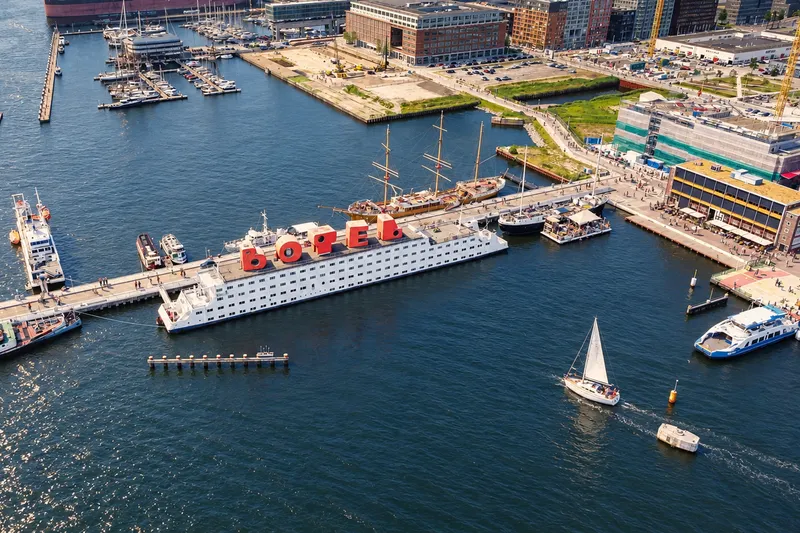
I then add the full price with tax and the daily commute. My shortlist below covers three different answers: Botel Amsterdam for easy ferry access, Hotel Asile Flottant for a whole historic boat, and Hotelboot Zwaan for a self-catering winter week. None is a universal winner, and one is useless if your trip falls in summer.
How I Compare a Long Stay Floating Hotel in Amsterdam
My Five-Point Test for Living Aboard
My first question is not whether the boat looks good. It is whether two people can unpack, work, sleep and move without constantly shifting bags. A stationary hotel boat is still a hotel; a houseboat may be a studio, a whole vessel or just a private room. Neither label promises a kitchen, a weekly discount or permission to register the address.
For stays of seven nights or more, I rank the practical points in this order:
- Storage: a place for luggage that does not block the berth, bathroom or exit.
- Berth comfort: protection from wake, workable heating and enough ventilation to control condensation.
- Weekly terms: the maximum stay, cancellation conditions and any genuine long-stay discount in writing.
- Daily services: a private bathroom, reliable internet in the actual cabin and access to laundry.
- Transport: a route to Centraal that still works when you are tired, carrying groceries or travelling late.
I would treat a seven-night minimum as a restriction, not a bargain. A weekly rate only counts as a discount when you compare the final amount with the same dates, boat and cancellation terms. Open water views are lovely, but they do not dry socks.
The Real Weekly Price: VAT, Tourist Tax and Deposits
For short-stay accommodation in the Netherlands in 2026, including boat cabins, VAT is 21%. Amsterdam also charges tourist tax at 12.5% of the overnight price excluding VAT. If a quote gives a pre-tax accommodation total of ≈ $770 (€700), VAT adds ≈ $160 (€147) and tourist tax adds ≈ $96 (€87.5), producing a final price of ≈ $1,000 (€934.5). A refundable deposit sits on top of that cash requirement, but it is not part of the accommodation cost.
The simple calculation is: final price = base price × 1.21 + base price × 0.125. That means base price × 1.335 when both charges are absent from the quote. The rates come from the Belastingdienst guidance on accommodation VAT and the City of Amsterdam tourist-tax rules. I would ask for one invoice showing both lines rather than comparing cheerful nightly numbers.
Asile Flottant adds a particular wrinkle: its booking total may still use 6% VAT, while the 2026 rate for short stays is 21%. That is a 15-percentage-point gap, so I would not pay until the invoice uses the correct rate. Hotelboot Zwaan has the opposite, pleasingly old-school problem: cash is due on arrival, cards are not accepted, and the room or entrance key carries a ≈ $22 (€20) deposit.
Amsterdam Botels and Houseboats for Weekly Living
The Shortlist at a Glance
These three are not interchangeable. Botel Amsterdam sells hotel cabins with private bathrooms, Asile Flottant offers individual historic vessels, and Zwaan mixes compact cabins with a much larger Captain’s Lodge. The table compares the version of each stay that makes most sense for a week.
| Name | City | Type | Price from | Main advantage | Main drawback |
|---|---|---|---|---|---|
| Botel Amsterdam | Amsterdam | Stationary botel | Date-based cabin quote | Private bathroom in every room; about 250 metres to the free F4 ferry | Cabin-style living without a self-catering setup; a more exposed IJ mooring |
| Hotel Asile Flottant | Amsterdam | Heritage converted houseboats | Date-based boat quote | Six individual historic boats at De Ceuvel, with more living space than a standard cabin | 50% booking payment, refundable ≈ $220 (€200) bond and a VAT calculation that needs correction |
| Hotelboot Zwaan | Amsterdam | Seasonal botel | ≈ $110 (€100) per day for Captain’s Lodge | 50 m² lodge with kitchen, two bedrooms and laundry set; seven-night minimum | Amsterdam only from early October to late March; cash payment and ≈ $22 (€20) key deposit |
I would not build a weekly budget around copied prices for AmicitiA, Vita Nova, MPS Holland, Passengership Avanti, Hotelschip Gandalf, Anna Maria II or Houseboat Little Amstel. Ask the owner for a dated quote naming the exact cabin, bathroom, berth and tax total. A cheap nightly figure is not much use if it belongs to a different room or season.
Botel Amsterdam: The Easy Commute Choice
Botel Amsterdam sits at NDSM-pier 3 on the former NDSM shipyard in Amsterdam Noord. Every room has its own small bathroom and toilet, which matters far more on night six than a decorative porthole does. Rooms look toward the harbour or the IJ, and the shared bar and roof terrace give you somewhere to sit when the cabin starts feeling small.
The transport connection is the strongest reason to book it. The free F4 ferry between NDSM and Amsterdam Centraal leaves from roughly 250 metres away, and the crossing takes about 10 minutes. That is a much easier weekly routine than relying on a paid shuttle or a long walk with shopping bags. The Botel Amsterdam room and ferry information also makes clear that breakfast inclusion depends on the selected booking offer.
My choice here would be a solo work trip or a couple who plans to eat out. I would skip it for a self-catering family week: the setup is still a hotel cabin, and NDSM restaurants can turn feeding everyone into a sizeable second bill. Its exposed IJ setting also makes it less appealing to a very light sleeper than a sheltered basin.
Asile Flottant and Zwaan: More Boat, More Responsibility
Hotel Asile Flottant has six restored vessels at De Ceuvel in Amsterdam Noord. They are individual spaces, not six copies of the same hotel room. De La Soul, for example, combines its wheelhouse, kitchen and living area, while UK85 has two separate bedrooms. I would pick a specific boat after looking at its bed layout and cooking space, not book the name and hope for the best.
The Asile Flottant reservation terms require 50% of the total at booking and the remaining 50% 30 days before arrival; inside that window, full payment is due. A ≈ $220 (€200) security bond is payable on arrival and returned after a damage inspection. For a quiet creative week, I like the extra living space. For anyone with a tight cash-flow limit, the payment schedule and bond are less charming.
Hotelboot Zwaan is the winter specialist. It is stationed in Amsterdam from early October until the end of March and works as a cruising boat the rest of the year. Captain’s Lodge offers 50 m² for one to four people plus a child, with a kitchen, two bedrooms, hot shower, laundry set and wheelhouse. The Zwaan cabin and lodge details put it from ≈ $110 (€100) per day with a seven-night minimum. At that price, I would gladly tolerate the cash-only ritual; outside the Amsterdam season, I would stop looking and choose another boat.
Daily Moored Living: Storage, Damp and Wake
Cabin Storage and the Case Against a Giant Suitcase
On a steel hull, the shape of the ship eats into the room. Rounded sides, framing and low lockers can leave plenty of floor area on paper but nowhere useful for a rigid suitcase. A large spinner often ends up standing open across the only clear route between bed and bathroom. That gets old before the first breakfast.
I would bring one soft duffel per person and packing cubes rather than a hard case. A soft bag compresses under a berth or into an awkward locker, and cubes let you keep seven days of clothes accessible without unpacking onto every surface. A hanging shoe organiser is useful for toiletries and chargers too, provided it does not cover a vent or emergency route.
Accessibility deserves the same blunt assessment. Gangways can be narrow and steep, and historic vessels may have ladders between decks rather than hotel-style stairs. Do not count on a lift or step-free route. Travellers with limited mobility, heavy camera cases or large hard luggage should treat a houseboat stay very differently from a serviced apartment. The site’s floating-hotel packing guide and cabin layout guide are useful for choosing bags and understanding tight quarters.
Heating, Condensation and Passing-Vessel Wake
Warm air plus cold steel is a reliable recipe for condensation. In cool weather, moisture can collect around metal frames, portholes and outside walls, especially where a suitcase or curtain blocks airflow. Keeping the cabin hot without ventilating it can make the air feel heavy while clothes remain damp. The fix is steady, moderate heat combined with short ventilation periods when conditions allow.
I would leave a small gap between luggage and exterior walls and avoid drying wet laundry over the heater. A compact boat with a kitchen also needs ventilation after cooking, or breakfast can become an unrequested humidity treatment. For cold-season stays, the guide to heated Amsterdam botel cabins and canal damp explains why insulation matters more than a thick duvet alone.
Motion is the other sleep issue. Botel Amsterdam’s IJ setting is more exposed to wake from passing ferries, barges and water traffic than the more sheltered De Ceuvel moorings. That does not mean constant rolling, but a sensitive sleeper may notice intermittent movement. Moored vessels do not normally need their propulsion engines running; the more relevant noise can come from ventilation fans, neighbouring boats and waterside activity. The guide to motion on moored floating hotels covers berth choice and remedies without pretending every ship moves alike.
Remote Work and Getting Across the IJ
Wi-Fi, Cooking and Laundry Without Wishful Thinking
A steel hull can weaken mobile reception below deck, much like a partial Faraday cage. Hotel Wi-Fi can also be strong in the lounge and feeble in a cabin at the far end of the passage. For video calls, I would want the signal measured inside the booked room, not a general promise that the boat has internet. A backup mobile data plan is sensible, but it is not magic if your cabin also suppresses cellular reception.
The practical options differ sharply by property. Asile Flottant’s boat layouts vary, so cooking facilities depend on the vessel chosen. Zwaan’s Captain’s Lodge has both a kitchen and laundry set, making it the clearest fit for an autonomous week. Botel Amsterdam suits someone happy with breakfast arrangements and restaurants rather than home cooking.
Outside Zwaan’s lodge, I would not assume that a guest washing machine is available. Amsterdam self-service laundries, usually called a wasserette, are the fallback; factor in the walk, waiting time and another bag to carry along the gangway. The guide to Wi-Fi on metal-hull boats explains the reception problem in more detail. My own rule is simple: if both work calls and laundry are essential, a vague reply is not enough.
F4 Ferries and Paying for the Rest of the Journey
GVB’s F1–F7 ferries across the IJ are free for pedestrians, cyclists, moped riders and passengers using mobility aids. That includes F4 between NDSM and Centraal. The roughly 10-minute crossing makes Botel Amsterdam easy to use as a base, but the walking distance and waiting time still belong in your commute calculation.
F4 departure intervals change with the day and operating period, so use the GVB journey planner for your travel dates rather than memorising one timetable. This matters most for an early work call or a late return. Missing a departure is considerably less picturesque when it is raining sideways.
For GVB trams, buses and metro services, OVpay accepts contactless debit and credit cards, phones and smartwatches, alongside ticket options. Use the same physical card or device to check in and out: a phone linked to the same bank account still counts as a different payment method. Anonymous OV-chipkaart sales ended on 1 July 2026, so I would not arrive expecting to buy one. For a short visit, a contactless card kept separate from your wallet is the least fiddly option.
Longer Stays: Contracts, Registration and US Passports
When a Hotel Week Turns Into a Residential Question
A hotel reservation is not automatically a Dutch residential tenancy agreement, or huurovereenkomst. Once a booking passes 30 days, I would ask exactly what contract is being offered, the maximum permitted stay and what happens if you need to extend. An Amsterdam houseboat extended booking should give you those answers in writing before you build a work assignment or relocation around it.
If you will live in the Netherlands for more than four months, address registration becomes part of the plan. Registration in the Personal Records Database leads to a citizen service number, or BSN, and requires proof that you may reside at the address. A boat hotel cannot be assumed to offer that right merely because it accepts a long booking.
Shorter stays can have their own registration route when a BSN is needed for work or services, but that is different from treating a tourist cabin as a permanent home. If registration matters, resolve it with the property and municipality before paying. Otherwise, a serviced apartment with an explicit residential setup may be the less entertaining but much smarter choice.
US Travellers: The 90/180 Limit and Passport Details
US passport holders do not need a visa for a short tourist visit to the Netherlands, but Schengen visa-free travel is limited to 90 days within any 180-day period. Time spent elsewhere in Schengen counts too. A long boat stay does not pause the clock just because the gangway feels pleasantly separate from the rest of Europe.
For visa-free entry, the passport should remain valid for at least three months after your planned Schengen departure and have two blank pages. The 12-page US emergency passport is not accepted for visa-free entry to the Netherlands. I would check those details before paying a non-refundable balance; losing the cost of a long booking over a passport technicality would be an expensive souvenir.
Which Floating Base I’d Book for a Week or More
Three Scenarios, Three Different Answers
If I wanted the simplest solo week, I would take Botel Amsterdam and accept the cabin format in exchange for the F4 connection. For privacy, cooking space and a quieter berth, I would price a specific Asile Flottant boat. For an autumn or winter stay where the kitchen and laundry genuinely matter, Captain’s Lodge on Zwaan is the most interesting value.
| Your priority | My pick | Why it works | Reason to choose something else |
|---|---|---|---|
| Fast commute and private bathroom | Botel Amsterdam | About 250 metres to free F4 and a 10-minute crossing to Centraal | You want a kitchen, lots of unpacking space or the calmest possible berth |
| Creative retreat or couple’s week | Hotel Asile Flottant | Individual historic boats and more residential living space at De Ceuvel | The 50% payment schedule, ≈ $220 (€200) bond and invoice correction do not suit you |
| Self-catering from autumn through winter | Hotelboot Zwaan, Captain’s Lodge | 50 m², kitchen, two bedrooms and laundry set for stays of seven nights or more | Your trip is outside early October to late March, or you cannot pay cash on arrival |
If none of those trade-offs appeals, I would book a serviced apartment and visit a boat for dinner instead. Living on a boat in Amsterdam is worthwhile when you actually want the boat routines. It is not worth paying extra to imitate an apartment with worse storage and a damper wardrobe.
What to Sort Out Before Paying
The best booking is the one with the fewest surprises after arrival. I would keep the entire agreement in one email thread: accommodation total, taxes, payment schedule, cabin name, services and cancellation terms. That also makes it easier to compare a weekly boat hotel booking with an apartment on equal terms.
One last distinction: a weekly rate reduces nothing unless the final invoice proves it, and a refundable bond still needs to fit your available funds. Once those numbers are clear, choose the berth that matches your sleep, work and commuting needs rather than the prettiest deck photograph.
Before sending payment, settle these five points:
- Get the weekly total, maximum stay and cancellation terms in writing, including any long-stay discount.
- Ask for an invoice showing 21% VAT and Amsterdam’s 12.5% tourist tax separately.
- Confirm the deposit and payment method: ≈ $220 (€200) at Asile Flottant, or cash on arrival plus the ≈ $22 (€20) key deposit at Zwaan.
- Request a Wi-Fi speed result for the exact cabin and identify the nearest laundry unless your booked unit has one.
- Use GVB’s planner for your ferry dates; for stays beyond 30 days, get the contract type and any address-registration position in writing.