 Floating Hotel
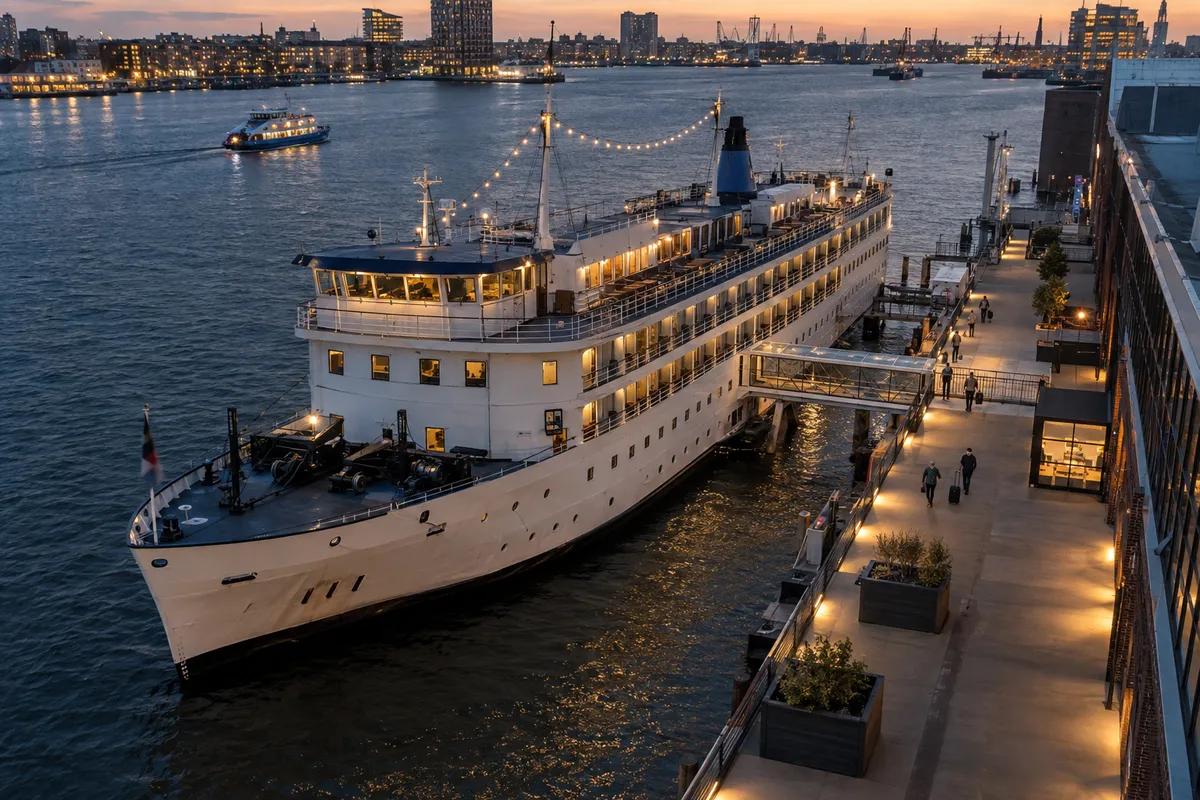
A berth at a pier offers a perspective on a city that no street-side room can match, but European floating hotels also come with operational realities that standard booking portals rarely disclose. Across twelve years of inspecting waterborne lodging, I have learned that a tranquil photograph often conceals rigid gangways, structural hull hums, and strict municipal taxes that alter the nightly bill.
Understanding how a permanently moored hotel ship functions—from municipal utility umbilicals and graywater macerators to seasonal water level shifts—is essential before booking. This comparative assessment evaluates eleven audited properties across European canals, rivers, and impounded maritime docks to provide the precise measurements, hull mechanics, and practical logistical details needed for an informed stay.
Evaluating European Floating Hotels: Methodology, Mooring Types, and Nautical Realities
Selection Methodology: Maritime Safety, Berthing Licenses, and Vessel Classification
Every vessel in this registry was evaluated against four strict technical benchmarks: legal berthing status, shoreside utility integration, structural fire safety, and usable net cabin space. I exclude temporary river cruise stopovers and uninspected private charters, focusing exclusively on static commercial botels and custom pontoon structures holding verified municipal permits.
The critical difference between an improvised barge and a compliant botel accommodation Europe offers lies in the shore connection. A legitimate quayside berth relies on dedicated shore power, pressurized municipal freshwater lines, and direct blackwater discharge into the urban sewer system. Vessels running diesel auxiliary generators at night create persistent low-frequency vibration and exhaust smells that penetrate lower-deck portholes.
Check whether a floating property is categorized as a permanently moored vessel or a certified passenger ship. Static pontoons must adhere to municipal structural codes, whereas historic steel hulls require periodic drydock surveys to ensure hull plate integrity.
Technical Realities: Macerator Mechanics, Water Systems, and Mandatory Urban Fees
Sanitation aboard floating accommodations operates on marine principles rather than municipal gravity plumbing. Nearly every water-level cabin relies on a marine macerator toilet equipped with high-speed motorized impellers that shred waste into narrow discharge pipes. Flushing wet wipes, sanitary products, or heavy paper jams the pump instantly, resulting in an immediate blackwater backup into the shower pan.
Mandatory local surcharges also diverge significantly between water-based properties and conventional hotels. In Amsterdam, stays are subject to the Dutch national accommodation VAT of 21% alongside a municipal tourist tax of 12.5% calculated on net room charges, as detailed on the Dutch Government Business Portal. By contrast, Prague levies a flat local stay fee of 50 CZK per adult per night, payable directly upon check-in.
Incidental authorizations on waterborne hotels can tie up substantial funds. Botel Amsterdam imposes a mandatory €50 refundable card deposit per room, Hotel CPH Living authorizes a 500 DKK pre-arrival damage hold, and Arctic Bath charges a flat 500 SEK fee for domestic pets.
Master Fleet Breakdown: Verified Moored Hotels in Europe
The European Moored Fleet at a Glance
The matrix below compiles eleven verified floating properties across eight European destinations, spanning converted industrial cargo hulls, decommissioned tenders, and stationary luxury yachts. You can cross-reference these findings with our broader assessment of European urban botels to plan multi-city itineraries.
Filter parameters to consider when evaluating these berths include vertical companionway access versus passenger elevators, active climate control versus natural ventilation, and the presence of full onboard dining versus room-only setups.
| Property Name | City & Country | Vessel Type | Price From | Key Advantage | Key Drawback & Operational Constraints |
|---|---|---|---|---|---|
| Botel Amsterdam | Amsterdam, Netherlands | Converted Botel & Rooftop Suites | €95 | Free 13–14 min GVB ferry F4 crossing to Centraal Station | €50 card deposit; compounding 12.5% city tax + 21% accommodation VAT |
| Botel Matylda | Prague, Czech Republic | Twin-Hull Botel & Ristorante | €85 | Prime embankment berth on Masarykovo nábřeží near Dancing House | Klotylda guests must cross open pontoon deck to Matylda for breakfast |
| Sunborn London Yacht Hotel | London, United Kingdom | Stationary Superyacht Hotel | £163 | Enclosed non-tidal dock location; 2 min walk to Custom House (Elizabeth line) | Royal Victoria Dock setting lacks classic historical London canal atmosphere |
| OFF Paris Seine | Paris, France | Custom Pontoon Catamaran Hotel | €140 | Floating plunge pool and dining terrace 200 m from Gare d'Austerlitz | Evening bar patron foot traffic causes pontoon vibration; wake rocking from Seine barges |
| Fingal | Edinburgh, United Kingdom | Decommissioned Lighthouse Tender | £264 | Step-free gangway, passenger elevator, 2 accessible cabins, onboard smokehouse | Premium price point; Leith dock requires 5-min walk to Edinburgh Trams for Old Town |
| Arctic Bath | Harads, Sweden | Floating & Freezing Spa Cabins | 5,995 SEK | Summer free-floating / winter ice freeze-in; open-air river cold bath | Remote Lapland location (1 hr drive from LLA); 500 SEK fee for pets |
| Botel Albatros | Prague, Czech Republic | Historic Botel | €56 | Restored 1930s Art Deco styling in central Prague 1; direct river views | Compact 14 m² standard cabins; 50 CZK/night municipal tourist fee at check-in |
| Hotel CPH Living | Copenhagen, Denmark | Converted German Freight Barge | 1,400 DKK | Floor-to-ceiling harbor glass; Christianshavn waterfront location | No central mechanical AC (summer heat risk); mandatory 500 DKK pre-arrival deposit |
| Sunborn Gibraltar | Ocean Village, Gibraltar | 7-Deck Luxury Superyacht | £180 | Marina resort lifestyle with rooftop sundeck and Mediterranean climate | Former onboard casino repurposed to Borealis room; gaming moved off-vessel |
| Rygerfjord Hotel & Hostel | Stockholm, Sweden | Triple-Hull Historic Botel | 650 SEK | Unobstructed City Hall views across Lake Mälaren from Kajplats 13 | Steep companionway stairs; compact entry-level cabins with shared corridor facilities |
| The Red Boat | Stockholm, Sweden | Historic Steamer & Barge Combo | 590 SEK | Highly affordable central Södermalm waterfront accommodation | Economy single berths measure just 80 cm wide; communal maritime wet-rooms |
Urban Connectivity: Ferries, Rapid Transit, and Dockside Buffers
A floating hotel is only as convenient as its quayside transport links. In Amsterdam, guests berthed at NDSM Pier 3 board the municipal GVB ferry route F4, which provides free passenger transit between Amsterdam Centraal and NDSM-werf every 15 to 20 minutes with a scheduled crossing time of 13 to 14 minutes, according to the GVB Transit Schedule. However, winter fog or adverse weather can stretch headways, requiring an official 20-minute connection buffer for mainline rail connections.
Properties in London and Paris link directly into high-capacity rail lines. Sunborn London sits 350 meters from Custom House station, offering two-minute pedestrian access to the Elizabeth line and Docklands Light Railway. In Paris, OFF Paris Seine is moored 200 meters from Gare d'Austerlitz, serving Metro lines 5 and 10 as well as RER C. In Edinburgh, guests aboard Fingal walk five minutes to the Port of Leith tram terminus for direct rail transit to Princes Street.
Historic Botels in Europe: Converted Passenger Liners and River Barges
Prague’s Vltava River Botels: Matylda and Albatros
The Vltava river botels provide budget-conscious berths anchored against Prague's historic stone embankments. Moored at Nábřeží Ludvíka Svobody, Botel Albatros reopened following an extensive capital refit that introduced 1930s Art Deco interiors across 90 keys, comprising 84 standard 14 m² cabins, 3 Deluxe rooms (18 m²), and 3 family units (20 m²). While the finishes echo vintage ocean travel, the standard double cabins leave negligible room for hard-shell luggage alongside the fixed double berth.
Further upstream near the Dancing House, Botel Matylda uses a split-hull architecture along Masarykovo nábřeží. The complex consists of the converted historic cargo barge Matylda, housing six rooms and an Italian restaurant, and the newer hotel ship Klotylda, which holds the reception desk and eighteen guestrooms. Guests booked on Klotylda must cross an uncovered floating pontoon deck to reach the breakfast saloon on Matylda, exposing them to rain and river winds during autumn and winter mornings.
When checking in at Prague botels, keep local currency on hand. Front desks collect the Prague municipal fee of 50 CZK per adult per night separately from room tariffs, and card payment terminals at older gangways can experience intermittent cellular drops.
Stockholm’s Lake Mälaren Hulls: Rygerfjord and The Red Boat
Moored along the granite wall of Söder Mälarstrand, Stockholm's historic ships offer front-row panoramas of the City Hall across Lake Mälaren. Rygerfjord Hotel & Hostel spans three interconnected vessels berthed at Kajplats 13, encompassing 90 cabins. Accommodations range from compact shared-facility bunk quarters in the lower hull to private ensuite captain cabins on the upper deck, though access throughout requires negotiating steep metal stairs without luggage assistance.
A short walk eastward at Kajplats 10 sits The Red Boat, formed by two historic vessels: a 1914 steamer hull and the 1946 survey vessel Ran af Stockholm. While it delivers some of the most affordable waterfront beds in central Scandinavia, physical space is exceptionally tight. Economy single berths measure exactly 80 cm wide, and standard double cabins feature fixed bunks with less than a meter of floor clearance between the bed frame and the door.
Travelers navigating these Stockholm hulls must also prepare for authentic ship construction: raised steel door coamings measuring 15 to 25 cm high sit at every bulkhead passage. Carrying bags heavier than 15 kg down these narrow companionways requires genuine physical effort.
Converted Barges and Pontoon Stays: Canals and Tidal Harbors
Amsterdam’s Post-Industrial NDSM Waterfront: Botel Amsterdam
Berthed at NDSM Pier 3 in the city's former shipyard district, Botel Amsterdam offers standard river and land-facing cabins alongside architectural rooftop suites constructed inside massive red lettering. Entry-level rooms are utilitarian, featuring compact modular bathrooms and fixed double or twin berths designed for quick turnarounds rather than extended lounging.
Budgeting for this property requires rigorous accounting. While baseline cabin rates start at €95 per night, the final bill increases substantially once the 12.5% municipal tax and 21% accommodation VAT are calculated. Guests must also present a credit card at check-in for the mandatory €50 damage pre-authorization, which the hotel releases within seven business days after checkout following cabin inspection.
The location appeals to travelers seeking an alternative to the crowded canal belt, but the post-industrial wharf can feel desolate late on wet winter nights. You can examine alternative neighborhood docks in our overview of inspected European floating properties.
Minimalist Christianshavn Quayside Living: Hotel CPH Living
In Copenhagen, Hotel CPH Living takes a completely different approach to the water. Converted from a German cargo barge and berthed permanently at Langebrogade 1A, this boutique vessel houses twelve double rooms arranged along a central interior corridor. Each room features solid wood accents, heated flooring, and floor-to-ceiling glass walls positioned inches above the harbor surface.
The engineering reflects Danish minimalism, but it presents a thermal challenge during peak summer months. The barge does not have a central mechanical air-conditioning system. While opening the sliding water-level glass door introduces cool maritime drafts, it also allows early-morning harbor traffic noise, wake slap, and midges to enter the sleeping area.
The hotel processes a 500 DKK pre-arrival security authorization seven days prior to check-in, and the immediate quay is strictly pedestrian, meaning taxi drop-offs require rolling luggage across 100 meters of paved embankment.
Luxury Superyacht Hotels, Floating Catamarans, and Arctic Floating Cabins
Modern Maritime Luxury: Fingal Edinburgh, Sunborn London, and Sunborn Gibraltar
At the top of the European fleet sit purpose-built and comprehensively restored luxury hulls that eliminate typical botel compromises. Berthed at Alexandra Dock in Leith, Fingal is a 1963 Northern Lighthouse Board tender transformed into a 23-key boutique hotel comprising 22 guest cabins and the presidential Skerryvore Suite. The ship features an onboard galley smokehouse producing cured salmon for its two AA Rosette restaurant, full elevator access across decks, and two specially adapted Classic Cabins with wide entryways.
For guests concerned about movement, the Sunborn London Yacht Hotel provides maximum stability. Berthed at Royal Victoria Dock, this 108-meter non-motorized superyacht operates within an impounded, non-tidal dock basin. Because water levels remain controlled by dock gates, the boarding gangway maintains a level gradient, and the vessel experiences zero tidal movement or passing-ship swell across its 138 cabins.
In the Mediterranean, Sunborn Gibraltar delivers a seven-deck superyacht resort in Ocean Village Marina featuring 189 rooms, an outdoor pool deck, and a day spa. Guests planning a visit should note that the vessel's original onboard casino has been decommissioned and converted into the Borealis event venue; gaming operations now take place off-ship at Casino Admiral inside the marina complex.
Floating Pontoons and Sub-Arctic Freezes: OFF Paris Seine and Arctic Bath
Innovative hull design extends well beyond converted steel ships. Berthed at 86 Quai d'Austerlitz, OFF Paris Seine is a stationary 58-key catamaran botel consisting of 54 double cabins (14 m²) and 4 larger suites. The central pontoon features a floating plunge pool and an active lounge bar, but this social setup comes at a cost: evening foot traffic creates noticeable pontoon vibrations, and commercial barges traversing the Seine produce rolling wakes until late evening.
In Swedish Lapland, Arctic Bath in Harads represents the extreme end of floating cabins Europe offers. Berthed on the Lule River, its six floating 24 m² Water Cabins connect to 57.5 m² private sun decks. The physical environment shifts dramatically by season: the cabins float freely on river currents through the summer, then freeze solidly into thick surface ice from mid-November to mid-April.
The central attraction at Arctic Bath is its circular timber spa, housing wood-fired saunas and a central open-air river bath cut directly through the surface ice. Reaching this remote outpost requires a one-hour road transfer from Luleå Airport (LLA), and guests bringing dogs must register in advance and pay a 500 SEK cleaning surcharge.
If visiting Arctic Bath between December and March, pack slip-resistant boots. The timber gangways connecting the shore to the frozen cabins develop surface frost, making wheeled luggage unmanageable across the snowpack.
Hull Physics, Gangways, and Cabin Ergonomics: Practical Trade-offs
Motion Dynamics, Wake Slap, and Noise Mitigation
Moored vessels behave according to the water bodies they inhabit. Closed basins like London's Royal Victoria Dock provide a motionless platform comparable to a land building. Conversely, active commercial rivers like the Seine and the Vltava expose hulls to periodic hydrodynamic displacement whenever cargo barges or tourist catamarans pass by.
Acoustic insulation on water requires specific defenses. When waves hit a vertical steel or timber hull, the resulting wake slap produces sharp sound peaks between 60 and 70 decibels. Concurrently, dockside electrical transformers and onboard pumps generate a continuous low-frequency hum (30–100 Hz) that travels directly through bed frames bolted to the deck plates.
High-density foam earplugs rated between 30 and 35 dB SNR dampen wave splashes effectively, but they cannot block low-frequency structural hull vibrations. Light sleepers staying on active waterways should pair physical earplugs with ambient pink or brown noise apps to smooth out sudden acoustic peaks.
Gangway Gradients, Luggage Navigation, and Physical Accessibility
Boarding a floating property involves navigating mechanical gangways subject to varying municipal and environmental conditions. Converted luxury vessels like Fingal and Sunborn London incorporate step-free boarding ramps with non-slip treads that accommodate wheelchairs and heavy rolling cases seamlessly.
Historic conversions present far steeper physical barriers. The Red Boat and Rygerfjord in Stockholm require stepping across pivoting metal ramps onto narrow exterior gangways, followed by near-vertical companionways angled at up to 60 degrees. Watertight bulkheads mandate high step-overs at every doorway, making these ships unsuitable for travelers with restricted mobility.
Before confirming a reservation on any historic hull, review your physical capabilities against the access points. If carrying bags over 20 kg, request a main-deck cabin to avoid hauling luggage down steep spiral stairwells.
Final Booking Verdict: Matching European Floating Hotels to Your Travel Persona
Categorical Recommendations by Traveler Profile
Choosing the right vessel depends on balancing budget limits against tolerance for compact quarters and marine mechanical quirks:
- Budget & Solo City Explorers: Book Botel Albatros in Prague for its €56 entry rate and quick access to Old Town, or secure an 80 cm bunk berth at The Red Boat (from 590 SEK) if central Stockholm location outweighs personal space.
- Design & Atmosphere Seekers: Choose Hotel CPH Living (1,400 DKK) for Danish waterside minimalism, or book OFF Paris Seine (from €140) if you value a lively cocktail deck over nighttime silence.
- Uncompromising Luxury & Accessibility: Reserve a cabin on Fingal (from £264) in Edinburgh for exceptional dining and step-free access, or select Sunborn London (from £163) for Elizabeth line transit and a motionless dock berth.
- Wilderness Immersion: Secure a Water Cabin at Arctic Bath (from 5,995 SEK) to experience Arctic river ice swimming from your doorstep.
Seasonal Mooring Strategies and Pre-Arrival Verification Checklist
Seasonal shifts alter vessel performance significantly. Summer stays on converted barges offer long daylight hours on open decks, but sun exposure turns unconditioned cabins like those on Hotel CPH Living into greenhouse traps. Winter visits across northern waters offer cozy interiors, but freezing winds sweep across open gangways.
Before arriving at any European floating accommodation, execute this four-point operational check:
- Confirm Local Tax Payment Methods: Verify whether local lodging charges (such as Prague's 50 CZK fee) must be paid in cash at check-in or can be billed to your card.
- Review Credit Card Pre-Authorizations: Ensure your card limit accommodates temporary security holds (€50 at Botel Amsterdam; 500 DKK at Hotel CPH Living).
- Check Summer Climate Control: If booking between June and August, confirm whether your cabin includes central mechanical air conditioning or relies solely on openable portholes.
- Audit Luggage Dimensions: If staying on historic hulls in Stockholm or Prague, switch to lightweight duffel bags that fit through 70 cm companionways and over watertight bulkheads.