

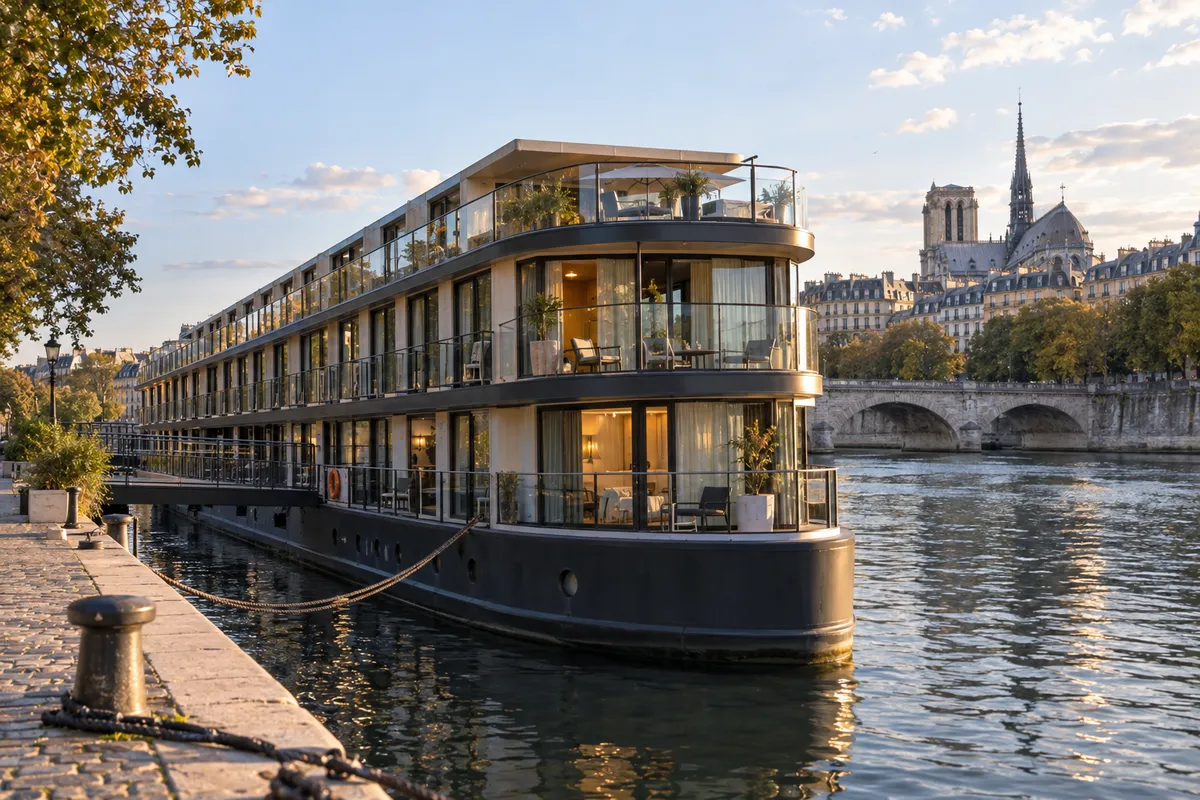
Urban floating hotels offer an immediate logistical trade-off: you gain water-level skyline views and direct proximity to historic city centers, but you give up standard hotel infrastructure like curbside taxi drop-offs, expansive luggage elevators, and motionless floors. Over twelve years of boarding harbor vessels across the globe, I have found that staying on the water during a fast-paced city break provides a distinct separation from street-level crowds, provided you understand the mechanical and nautical realities of your berth.
Mooring lines stretch, steel hulls transfer ambient river temperatures, and commercial boat wakes create subtle daytime motion. Choosing central floating accommodation over a land-based room requires evaluating dock access, municipal transit links, interior cabin dimensions, and municipal surcharges before rolling your luggage down an articulated gangway.
Selection Methodology: How We Screened Downtown Botels and Harbor Ships
Core Urban Criteria: Mooring Locations, Transit Access, and Vessel Legitimacy
To qualify as a genuine base for a city break on the water, a vessel must offer direct urban integration rather than an isolated maritime retreat. I excluded rural eco-lodges, anchored wilderness rafts, and remote marina pontoons from this assessment. Every reviewed property must sit within municipal city limits and maintain a walking transit time of ten minutes or less to a rapid transit station, metro entrance, or public ferry terminal.
Vessel legitimacy is equally non-negotiable. I only included permanently moored, commercially licensed stationary hospitality properties connected to dedicated shore-side utilities for electricity, municipal water, and blackwater discharge. This rules out working cruise vessels running intermittent overnight hotel stays and unregulated private houseboats. Navigating these waterways also involves three distinct physical environments: enclosed, impounded docks with steady water levels like Royal Victoria Dock in London and Alexandra Dock in Edinburgh; tidal river basins like the Seine; and calm freshwater bodies such as Prague’s Vltava River or Stockholm’s Lake Mälaren.
Technical Evaluation: Gangways, Vessel Motion, and Waterline Acoustics
Evaluating an urban floating hotel demands scrutiny of hull engineering and passenger access. Unlike standard masonry buildings, a botel or converted vessel interacts continuously with surrounding water. I assessed each vessel’s mooring assembly, checking whether it relies on fixed spud poles, vertical dolphin guide pilings, or shore-fast wire spring lines, all of which dictate how the hull responds to passing vessel wakes and wind chop.
Acoustic insulation is another critical metric. A waterline cabin places your head near or below the river surface, where the sound of lapping water, hull creaks, and diesel engines from early morning commuter ferries can travel through uninsulated steel plates. I looked for double-glazed viewports and acoustic bulkhead dampening. Finally, companionway ergonomics determine everyday comfort. Many historic hulls retain high-threshold watertight coamings and steep internal companionway stairs pitched at steep angles, making heavy luggage transfers difficult for unprepared travelers.
Comparative Analysis: Central Floating Accommodation at a Glance
Specification and Interactive Directory of Urban Floating Hotels
The comparative directory below compiles key operational data for central urban botels and floating ships across European destinations. Use the architecture and pricing metrics to align each property with your transit needs and luggage tolerance. For an extended analysis of regional fleet conversions, consult our European urban botels guide.
Specification for future widget controls: Filter options should support Vessel Architecture (Converted Cargo Barge, Stationary Pontoon/Catamaran, Historic Working Vessel/Tender, Superyacht Hotel). Sort controls should toggle between Base Nightly Rate and Transit Walk Time to heavy rail, metro, or public ferry links.
| Hotel / Ship | City & Country | Vessel Type | Price From | Primary Advantage | Primary Drawback |
|---|---|---|---|---|---|
| Botel Amsterdam | Amsterdam, Netherlands | Botel & Letter Suites | €95 | Direct municipal ferry connection to Amsterdam Centraal | Early morning F4/F5 ferry gap requires detour via 24/7 F3 ferry |
| Hotel Asile Flottant | Amsterdam, Netherlands | Heritage Workboats | €165 | Individual historic ship hulls moored in De Ceuvel eco-quarter | Self-check-in with no traditional front desk or on-site restaurant |
| Botel Matylda | Prague, Czech Republic | Botel & Ristorante | €85 | Historic Old Town quay mooring right by the Dancing House | Steep companionway stairs and no passenger luggage elevator |
| Botel Albatros | Prague, Czech Republic | Historic Botel | €56 | Art Deco 1930s refit cabins at accessible budget rates | Compact standard cabin footprints of roughly 9 to 10 m² |
| Sunborn London Yacht Hotel | London, United Kingdom | Superyacht Hotel | £180 | Elizabeth line connection to Central London in 15 minutes | Enclosed docklands area feels quiet outside ExCeL event dates |
| Fingal | Edinburgh, United Kingdom | Luxury Boutique Ship | £264 | Heritage lighthouse tender conversion with five-star naval service | Leith berth requires a 20-minute tram ride to city center |
| OFF Paris Seine | Paris, France | Stationary Catamaran | €150 | Central river mooring with open-deck plunge pool lounge | Quayside road noise and mandatory gate access codes for vehicles |
| Hotel CPH Living | Copenhagen, Denmark | Converted Barge | 1,400 DKK | Floor-to-ceiling glass walls directly facing harbor waters | Reception desk unstaffed after 18:00; narrow stairs without elevator |
| Rygerfjord Hotel & Hostel | Stockholm, Sweden | Botel & Hostel Ship | 650 SEK | Lake Mälaren panorama facing Stockholm City Hall | Shared bathroom facilities in entry-level economy cabins |
| The Red Boat | Stockholm, Sweden | Co-living Boat Hotel | 590 SEK | Affordable historic harbor base near Södermalm district | Extremely compact bunk layouts with vertical access ladders |
Hidden Costs: Quayside Municipal Taxes and Harbor Surcharges
Booking downtown botels often reveals municipal surcharges that diverge sharply from standard inland hotel fees. Local authorities increasingly impose targeted municipal taxes on waterfront lodging, and these fees must be factored into your total trip expenditure.
In the Netherlands, Amsterdam levies an overnight tourist tax of 12.5% on the net room rate, which is coupled with the national VAT rate of 21% on accommodation confirmed by the Ministry of Finance. For guests checking into OFF Paris Seine, the City of Paris enforces a mandatory tourist tax of €8.45 per adult per night for four-star rated floating establishments, an amount that includes the regional transit surcharge established by the French Public Service Directory. Prague imposes a municipal accommodation fee of 50 CZK per person per night for guests aged 18 and older, collected separately at check-in along the Vltava quays.
Conversely, London, Edinburgh, Copenhagen, and Stockholm do not charge separate quayside municipal bed taxes at reception. Their quoted rates include standard national VAT (20% in the UK, 25% in Denmark, and 12% in Sweden), meaning the final price confirmed during booking is what you pay upon arrival.
Converted Cargo Barges and Heritage Working Vessels
Minimalist Nordic Harbor Living in Copenhagen and Amsterdam
Hotel CPH Living provides a prime example of industrial maritime repurposing. Moored permanently at Langebrogade 1A in Copenhagen’s Christianshavn neighborhood, this 12-room hotel was built upon a former German freight barge. The design uses light wood, radiant underfloor heating, and floor-to-ceiling glass viewports that sit roughly one meter above water level, facing Christiansborg Palace across the harbor channel. The property operates with automated door codes after the reception desk closes at 18:00, and its metal companionway requires travelers to haul bags down narrow steps.
In Amsterdam-Noord, Hotel Asile Flottant sits within the De Ceuvel cleantech community along the Johan van Hasseltkanaal. Rather than operating as a singular hotel vessel, it comprises six individually restored heritage cargo and work vessels. Each boat functions as an independent, self-contained suite featuring built-in galley kitchens and private deck space. Wastewater from the hulls is treated through an on-shore ecological phyto-purification system using cleansing plants. There is no central lobby or breakfast room, so guests use keyless door codes to access their vessels directly from the timber boardwalk.
Julian's Packing Tip: Converted freight barges feature steel framing that conducts cold harbor temperatures through the floors during chilly weather. Pack rubber-soled deck shoes or wool socks with grips; smooth soles slide easily on wet exterior gangways and chilly timber cabin floors.
Historic River Vessels and Classic Botels on the Vltava
Prague offers a high concentration of river accommodation along the Vltava River. Botel Matylda, moored at Masarykovo nábřeží near the Dancing House, consists of two connected ships: the historic iron cargo barge Matylda and the newer purpose-built vessel Klotylda. Cabins on Matylda feature dark hardwood trim, brass light fixtures, and low ceilings that reflect its working-barge origins. The aft deck houses an Italian restaurant hanging over the river current. Moving between decks requires navigating steep companionways with narrow treads, and neither vessel features a passenger elevator.
Further downstream by the Štefánik Bridge, Botel Albatros provides an accessible, budget-oriented stay on the water. Following a comprehensive capital refit that concluded late in 2026, the ship’s 90 cabins were refurbished with transatlantic Art Deco motifs, incorporating rounded woodwork, polished chrome, and geometric tiling. Cabins are compact, measuring 9 to 10 square meters, but standard rooms feature en-suite shower stalls and river viewports looking out toward Letná Park. For a broader look at river lodging along this waterway, browse our guide to Prague botels on the Vltava.
Luggage Advisory: The gangways leading from the Prague embankments down to Botel Matylda and Botel Albatros sit at steep angles during seasonal river fluctuations. Rolling heavy suitcases over the stone quay cobbles and down angled ramp joints requires reasonable physical strength.
Purpose-Built Floating Hotels and Permanently Moored Yacht Hotels
Impounded Dockland Luxury in London and Maritime Splendor in Edinburgh
Sunborn London Yacht Hotel represents a purpose-engineered luxury yacht design. Measuring 108 meters in length with 136 guest rooms, this non-motorized vessel is permanently moored inside the impounded basin of Royal Victoria Dock. Because the dock is enclosed by lock gates, the water level remains stable, eliminating the 7-meter tidal range seen on the open River Thames. Cabins are finished with glossy burr wood veneers, marble bathrooms, and outward-facing terraces. Fast transit into central London is straightforward: the Elizabeth line platforms at Custom House station are just 350 meters away, accessible via a flat five-minute walk through the Transport for London network, bringing passengers to Tottenham Court Road in 15 minutes.
In the historic Port of Leith, Fingal delivers an exceptional boutique ship conversion. Formerly a maintenance tender for the Northern Lighthouse Board, this 23-cabin vessel is berthed at Alexandra Dock. The conversion preserved the vessel’s heavy teak decking, polished exterior brass, and rich mahogany wall paneling, transforming former utility holds into curved duplex staterooms and bridge suites. A two-minute walk links the ship's boarding gangway to the Port of Leith tram stop, where Edinburgh Trams operate direct 20-minute runs to central Edinburgh Waverley station.
Stationary Catamarans and Urban Waterfront Hubs in Paris and Amsterdam
Moored at 86 Quai d'Austerlitz, OFF Paris Seine is a custom stationary catamaran comprising 58 guest rooms. Two floating hulls support an open central lounge, cocktail bar, and an elongated plunge pool set flush into the river deck. Waterline cabins sit level with the Seine's surface, offering views of passing river traffic. The trade-off is mechanical and environmental noise: commercial tour boats send wakes rolling into the hull throughout the day, and city traffic rumbles along the nearby quayside roadway. Arriving by vehicle requires careful planning, as private parking on the embankment is prohibited and guests must request an electronic access gate code from the front desk at least 24 hours prior to check-in.
Across the North Sea, Botel Amsterdam offers a lively 175-room hotel berthed at the creative NDSM Wharf. The vessel features bold rooftop architectural letters housing duplex loft suites designed by prominent Dutch interior architects. Getting to the city center relies on the municipal public transport network: free GVB ferry route F4 departs every 15 to 30 minutes for Amsterdam Centraal, as documented on the GVB route schedule. While daytime crossings take 14 minutes, the F4 service stops around midnight on weekdays. Night ferry F5 covers the crossing with wider 40- to 45-minute intervals, leaving early morning gaps where travelers must use the continuous 24/7 F3 ferry to Buiksloterweg and walk or cycle across North Amsterdam. Review our roundup of Amsterdam botels and ship hotels to compare berths across the IJ.
Historic Steamers, Liner Conversions, and Floating Resorts: Flotillas to Mega-Vessels
Stockholm’s Lake Mälaren Flotilla: Söder Mälarstrand Botels
Stockholm’s southern shoreline along Söder Mälarstrand accommodates several permanently berthed historic ships that provide budget-friendly rooms within walking distance of the trendy Södermalm district. Rygerfjord Hotel & Hostel links three separate historic vessels via timber gangways. Its prime asset is orientation: forward-facing deck cabins look straight across the calm freshwater of Lake Mälaren toward the red brick facade of Stockholm City Hall. Accommodations range from basic shared-bathroom bunks in the hull to private en-suite captain cabins finished in varnished pine.
A short walk along the quayside brings you to The Red Boat (Den Röda Båten), an establishment combining two vintage hulls: a 1914 steamship and the 1946 research ship Ran af Stockholm. Cabins here are compact and basic, emphasizing wood-paneled bunk berths that demand climbing vertical steel ladders. Mooring in Lake Mälaren’s freshwater eliminates the saltwater corrosion and ocean swell typical of maritime harbors. However, when cold winter temperatures arrive, freshwater freezes quickly. The solid ice encases the hulls, stopping all rocking motion while significantly increasing thermal heat loss through the underwater steel plates.
Ocean Liner Heritage and Marina Resorts: Dubai and Gibraltar
Urban floating accommodations also exist at a massive scale. In Dubai’s Port Rashid Marina, the iconic ocean liner Queen Elizabeth 2 operates as a 13-deck floating hotel managed by Accor. With 215 restored guest rooms, the ship retains its mid-century transatlantic architecture, featuring original maritime artwork, an on-board heritage museum, a cinema, and multiple dining rooms. Its substantial displacement makes vessel movement virtually imperceptible, serving as a tranquil port staycation destination adjacent to the historic Dubai Creek district.
In the Mediterranean, Sunborn Gibraltar occupies a purpose-built 142-meter superyacht hull moored inside Ocean Village Marina. The ship features an open-air plunge infinity pool at the top-deck Aqua Bar looking toward the Rock of Gibraltar, alongside on-board gaming tables at Casino Sunborn. The vessel combines the high-end finishes of a modern resort hotel with the immediate accessibility of Gibraltar’s downtown shopping and business districts, located a short seven-minute walk from the marina gangway.
Practical Realities: Wake Turbulence, Companionways, and On-Water Constraints
Physical Access: Steep Companionways and Tidal Incline Challenges
Accessibility on urban floating properties rarely matches the barrier-free standards of modern land-based commercial buildings. Historic conversions like Botel Matylda, Botel Albatros, The Red Boat, and Hotel CPH Living do not have passenger elevators. Navigating between reception and your room means carrying luggage up or down steep companionway stairs with narrow steps and low overhead clearance.
Gangways introduce another physical challenge. On tidal rivers or harbor channels with heavy water movement, boarding ramps pivot continuously across floating pontoon joints. During extreme low or high tides, the gangway's incline angle can steepen significantly. Travelers managing wheeled rolling bags must navigate raised structural coamings at exterior doors, installed to prevent deck wash from flooding interior corridors.
Structural Micro-Climate: Condensation, Soundproofing, and Water Safety
Sleeping at the water's edge involves a distinct micro-climate. The temperature difference between a heated cabin interior and the cold river water on the exterior hull often generates condensation along metal window frames and uninsulated lower bulkheads during spring and autumn nights. While passing boat wakes create gentle rocking on open waterways like the Seine, wake turbulence can disrupt light sleepers during peak morning river commuter hours; consult our guide on managing motion sickness on moored floating hotels for practical preparation.
Shipboard plumbing requires careful attention. Converted barges and classic botels rely on electric blackwater macerator pumps to push wastewater up into municipal shore mains. Flushing foreign objects, sanitary products, or heavy paper down marine toilets will burn out the macerator motor and quickly flood the cabin bathroom with wastewater. Finally, fire prevention onboard floating structures is exceptionally strict. All reviewed botels enforce strict indoor no-smoking bans backed by sensitive optical smoke detectors and substantial commercial cleaning penalties, often €250 or £250, because fire containment inside an enclosed hull is critical to vessel safety.
Verdict and Final Recommendations: Matching Urban Floating Hotels to Your City Break
Scenario Recommendations: Design Escapes, Solo Hubs, and Romantic Weekends
Choosing the right urban floating hotel comes down to matching your travel priorities with the vessel's specific layout and setting:
- Uncompromising Luxury and Maritime History: Choose Fingal in Leith for its restored mahogany craftsmanship, five-star naval service, and quiet docklands setting linked directly to central Edinburgh by tram.
- Vibrant Waterfront Social Atmosphere: Select OFF Paris Seine in Paris for its central river lounge, plunge pool deck, and direct views of passing Seine riverboats.
- Minimalist Architecture and Waterline Scenery: Book Hotel CPH Living in Copenhagen for heated timber floors, quiet harbor quarters, and floor-to-ceiling glass walls looking across the water toward the palace.
- Budget Solo Exploration: Pick Botel Albatros in Prague for its freshly renovated 1930s Art Deco cabins or The Red Boat in Stockholm for wallet-friendly bunk berths near central nightlife.
- Fast Transit and Executive Comfort: Reserve Sunborn London Yacht Hotel for its stable impounded dock berth, spacious staterooms, and rapid 15-minute Elizabeth line transit into London's West End.
When to Choose Quayside Mooring Over Traditional City Hotels
A floating hotel delivers an unforgettable city break if you value panoramic harbor mornings, the soothing sound of lapping water, and instant access to waterfront walkways and urban ferry networks. For many travelers, stepping out of an ordinary city street and onto an articulated gangway turns a routine overnight stay into a memorable journey.
However, you should stick to a traditional land-based hotel if you travel with bulky multi-piece luggage or have reduced mobility that makes steep stairs, raised door thresholds, and rolling gangways unsafe. Land hotels are also better suited for travelers who need curbside taxi drop-offs right at the lobby doors, 24-hour manned concierge counters, or guaranteed motion-free floors during stormy weather. For deeper details on daily life aboard stationary vessels, explore our comprehensive guide to cabin living on the water.